Showing posts with label writing tips. Show all posts

Thursday, August 29, 2019

Author Interview at NFReads.com

Today, NFReads published my author interview. They ask good questions, so if you want to know my dark secrets, take a gander. Just kidding. I kept my darkest secrets in a closet under two tons of rubbish.


P.S. Don't forget to pre-order No Peace, A Steve Dancy Tale

Monday, July 15, 2019


No Peace is one step closer to publication.

I have used the same editor for eleven books, and once again, I'm beholden to her for saving me embarrassment. I always think I've submitted a perfect manuscript, only to discover a prodigious amount of red ink on every page. Contrary to popular belief, novels are not entirely a solitary task. Beta readers, editors, book designers, and cover graphic designers all play a major part in bringing piece of fiction to market. I am grateful for them all.


Tuesday, February 19, 2019

Famous Last Words


The Washington Post has an article on “The 23 most unforgettable last sentences in fiction.” Many critics and readers focus on the first sentence, but the last sentence is the one that leaves the final impression. Here are a few of my favorites.


“I got to light out for the territory ahead of the rest, because Aunt Sally she’s going to adopt me and sivilize me, and I can’t stand it. I been there before.”
Adventures of Huckleberry Finn by Mark Twain
“It’s funny. Don’t ever tell anybody anything. If you do, you start missing everybody.”
The Catcher in the Rye by J.D. Salinger
“He was soon borne away by the waves, and lost in darkness and distance.”
Frankenstein by Mary Shelley
“After all, tomorrow is another day.”
Gone With the Wind by Margaret Mitchell
“He loved Big Brother.”
Nineteen Eighty-Four by George Orwell
I can't resist. Here are a couple of my favorites from my own books.

“I kept my head and Chestnut facing east.”
The Shopkeeper by James D. Best
(I didn’t want my hero to ride off into the sunset.)


“And then he was gone.”
Tempest at Dawn by James D. Best
(James Madison, an old man had left the room, but he soon after left the stage as our last remaining Founding Father.)


In truth, neither the first nor last sentence can make a good story. The entire narrative has to pull the reader forward until they read the last sentence. A story told properly will cause the reader to seek out another book by the same author.

Sunday, March 18, 2018

Mark Twain's 10 Writing Tips


Curiosity.com published a list of writing tips from Mark Twain. Now, Twain never actually published a list, but his letters provided plenty of tips that just needed to be gathered up in one place. 


1. "Write without pay until somebody offers to pay."
2. "Don't say the old lady screamed. Bring her on and let her scream."
3. "Great books are weighed and measured by their style and matter, and not the trimmings and shadings of their grammar."
4. "The time to begin writing an article is when you have finished it to your satisfaction."
5. "If I had more time, it would have been shorter."
6. "The more you explain it, the less I understand it."
7. "Substitute 'damn' every time you're inclined to write 'very.' Your editor will delete it and the writing will be just as it should be."
8. "The difference between the right word and the almost right word is the difference between lightning and a lightning bug."
9. "Use plain, simple language, short words, and brief sentences... don't let fluff and flowers and verbosity creep in."
10. "As to the adjective: When in doubt, strike it out.”

Good advice, but I believe scrutinizing Twain’s castigation of James Fennimore Cooper provides even more guidence. Among other things, Twain wrote “Cooper's art has some defects. In one place in "Deerslayer," and in the restricted space of two-thirds of a page, Cooper has scored 114 offenses against literary art out of a possible 115. It breaks the record.” 

If the criticisms of Cooper were rewritten as positive statements, they would make a great guide to great writing. Which I took the liberty of doing here. You may also want to check out my catalog of writing advice from the masters. 


Wednesday, January 29, 2014

How not to bore your readers

Charlie Jane Anders wrote a piece for io9 about How to Write Descriptive Passages Without Boring the Reader or Yourself. Her article includes some good advice, including:

  1. Commit to never being boring.
  2. Engage all five senses.
  3. Try being super terse.
  4. Make it dynamic rather than static.
  5. Make fun of the thing you're describing.
  6. Project feelings onto an inanimate object.
  7. Give your POV some visceral or emotional reaction.
  8. Use less dialogue.
  9. Use description to set up a punchline in dialogue.

I would add three more for an even dozen:
  1. Never start a book or chapter with too much description.
  2. Interleave description in small doses.
  3. Write about interesting places.

ghost town
Candelaria (aka Pickhandle Gulch)

I usually start chapters with action and then intersperse tight paragraphs of description. I prefer delivering description in a single paragraph at a time and seldom have more than two descriptive paragraphs in a row.  I also like to write about interesting places. Novels will take you to mundane locales, but you can always insert an interesting detail. 


The Steve Dancy Tales start in a Nevada mining camp called Pickhandle Gulch. I walked the current-day ghost town, fascinated by the miners’ rock igloos.  (The town must not have discouraged littering because the mouths of these rock dwellings were strewn with hundreds of rusted tin cans.)

Here is how I described the camp in The Shopkeeper.
Pickhandle Gulch nestled between the Silver Peak Range and the Excelsior Mountains. The main road curved up a mild grade toward a stamp mill, an ugly building that pulverized rock and made a nerve-racking noise all day long. About two dozen thrown-together buildings lined either side of a road, and hundreds of hovels scarred the surrounding slopes. Miners built these shelters with rocks because the beige hills that rolled off in every direction were completely barren of trees. For that matter, hardly any foliage reached above a man’s boots, and even the valley spread out below presented only a relentless brown landscape spotted with a few rocks and some pale sagebrush. Lumber was the second-dearest commodity in town. Water was the first.

western fiction
Honest westerns ... filled with dishonest characters.

Monday, January 27, 2014

Why are murder mysteries written in first person?

detective
Murder mystery fans like to figure out whodunit. It’s why the genre is fun, and enthusiasts hate it when the author rigs the game. No undisclosed facts or coincidences can miraculously solve the crime. Everything known to the detective must also be known to the reader. The most effective way to share information is to tell the entire story in first person. First person requires the narrator to be present in every scene, so everything she sees, the reader sees. Thus, most murder mysteries are written in first person in order to insure a fair challenge.

All the facts must be commonly known, but it’s legitimate to shield the reader from the thoughts of the detective. This is why many authors don’t use the protagonist’s point of view. The first person character can be a narrator sidekick, like in the Sherlock Holmes mysteries which are told by Dr. Watson. This is a handy device for facilitating a surprise ending. Although readers get to know all the facts, they don’t see the detective mentally unravel the incongruities of the mystery.

When I was figuring out a plot for the third Steve Dancy Tale, it occurred to me that I had all the elements in place for a murder mystery. I had started the series in the first person and another main character worked for the Pinkerton National Detective Agency. Everything fit for a murder mystery disguised as a western. Murder at Thumb Butte is a murder mystery that just happens to occur in the Arizona Territory. Since there were plenty of murders in the Old West, why couldn’t a mystery surround the one Steve Dancy needed to solve to save a friend? 

western fiction
Honest Westerns ... filled with dishonest characters

Tuesday, January 21, 2014

Outline a Novel?

Joseph Heller's Outline for Catch 22

How much planning should there be for a novel? Should there be an outline? Should you compose character sketches? How much research after the first draft?

My answer to all of these questions is that it depends.

Tempest at Dawn is a novelization of the constitutional convention. Prior to writing the first draft, I had visited Philadelphia twice, complied biographical information for the primary delegates, built a small library about the convention and eighteenth century lifestyle, created a highly detailed convention timeline, extensively marked-up Madison notes, acquired an 1787 map of Philadelphia, and secured architectural layouts for the State House. I knew the content of every chapter well before I started writing.


The Shopkeeper is the first in the Steve Dancy western series. I did zero research prior to the first draft, nor did I have an outline. Although I had nothing on paper, I mentally knew the beginning and end of the story, but how I would get from one point to the other was vague.  I also knew my main character and his sidekick, but the other characters evolved as the story progressed. After I finished the first draft, I collected some friends and did a road trip through Nevada to explore locales for the story. In fact, I asked my ghost town enthusiast friend to find me a mining camp within a few days horse-ride of Carson City. She did, and that is how the story opened in Pickhandle Gulch. After I did the Nevada research and investigated mining in the state, I rewrote the book from beginning to end.


These are two preparation extremes. Why the difference from the same author? Tempest at Dawn was a dramatization of arguably the most important event in the founding of the United States. Accuracy was paramount. It had to survive the scrutiny of professional historians, which it did with flying colors. The Shopkeeper was pure fiction with historical detail limited to locale and nineteenth century lifestyle.  The story was paramount. I wanted to get the story and the characters down on paper before interweaving detail that would make the novel feel right for the Nevada frontier.

The bottom line is that I do what feels right for the project. I don’t believe there is a right and wrong way. There is good advice out there from successful writers, but I believe good writers do what is natural for them. So … my advice is to go with your instincts.

Sunday, January 19, 2014

History Rides Shotgun—Excellent Advice


Jennifer Cody Epstein published, “10 Rules for Rewriting History” at Writer Unboxed.  As a historical writer, I found the article helpful and full of great advice. I think I've encountered all 10 issues, but number one, History Rides Shotgun, is my nemesis. I enjoy research and like fascinating factoids. It’s difficult for me to not look for a place to tuck in a real life incidence or coincidence that I think is interesting all on its own.

Epstein writes, “Remember that what you’re writing is a novel—not a history book. This means history should be used only to heighten and deepen your narrative, and not the other way around. Be careful not to get hijacked by some fascinating event that doesn’t fit naturally into your storyline, because no matter how hard you try it simply won’t work in the end. If it doesn’t relate to your plot, it shouldn’t be in there.”

Solid advice. I have a proclivity to violate this rule, so I need to be vigilant during revisions to look for extraneous information that does not advance the story.

action adventure suspense thriller
Honest westerns ... filled with dishonest characters
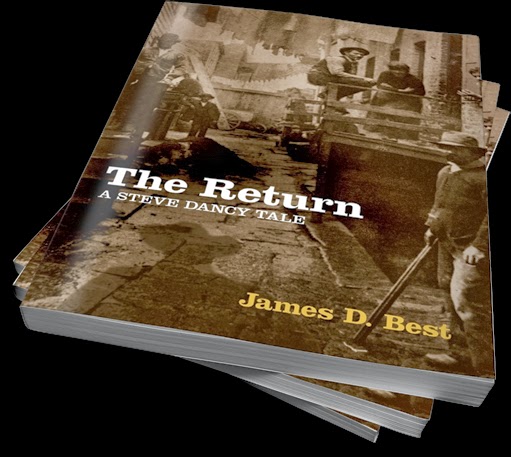
In the latest Steve Dancy Tale, The Return, Dancy and Sharp travel to see Thomas Edison in order to secure rights to his inventions for mining. In the research for the novel I discovered all kinds of interesting things about Edison, Menlo Park, New York City, and 1881 movers and shakers. I was also startled to discover that Edison owned mines and developed numerous patents that applied specifically to mining. It was difficult to avoid letting the Wizard of Menlo Park interfere with Dancy’s story. I succeeded by scrubbing the story during revisions and being conscious that this was a particular problem for me. I also used a technique that I’d like to add as a tip to Epstein’s Rules. At the end of the book, I added a “Historical Note.”  Through this device I was able to inform the reader about some historical tidbits without disturbing the flow of the story.

Related Posts

Monday, December 9, 2013

A Writing Cheat Sheet

Many seem to believe if they just got a proper set of instructions, they could be a good writer. Many famous writers like Mark Twain, George Orwell, and Elmore Leonard have even provided aspiring writers a list of rules.  Here is a Writing Tips PDF that collects rules from George Orwell, Edward Tufte, Strunk and White’s, and Robert Heinlein. I especially enjoyed Evil Metaphors and Phrases. These clichés are definitely cringe worthy, if I can be allowed to use yet another cliché.

(Here is my collection of writing advice.)

There's a problem with all of these lists. If hard rules were all that was necessary to become a great writer, then we’d be awash in breathtaking literature.  We have writing tips, rules, and guidelines aplenty, yet they don’t seem to convey the masters’ magic. What gives? All of the rules are good writing advice, but first there must be compelling content.

I used to golf until I realized I pretended to enjoy the game. Prior to making this discovery, I took a lesson with two friends from a teaching pro. We spent about two hours on the range and putting green. Lots and lots of tips and advice. My head was swimming. I couldn’t get my grip right for fear my backswing was too fast. 

The all-day lesson included a round of golf with the teaching pro. We presumed he would critique our play as we went along. No way. On the first tee, he told us he wouldn’t comment on our play until we were ensconced in the clubhouse for refreshments. He said we should forget everything he had told us. Forget it all. His advice was meant for the driving range and putting green. He reiterated that as we played this round, we were not to worry about grip, swing, or stance. We should concentrate on one thing and one thing only—keep our eye on the ball. Simple. Keep focused on the primary basic of all the basics. It was a fun round of golf with one of my lowest scores.

My point is that when you write a first draft, forget the rules. Focus solely on the story. Telling a great story is the real magic the masters have mastered. Don’t pull out the rules until you start the second draft, then use them ruthlessly on the third and fourth draft. Hone and polish your manuscript until it’s as bright and shiny as a new penny.  (Sorry, I couldn’t resist closing with an “Evil Metaphor.”)


Friday, October 18, 2013

Mark Twain Tells Us How to Write

Mark Twain didn't like James Fenimore Cooper’s writing. Wait, that was far too mild of a sentence. In his article “Fenimore Cooper's Literary Offenses,” Twain ridicules, lacerates, and skewers Cooper.

Here’s a small sample: 
Cooper's art has some defects. In one place in "Deerslayer," and in the restricted space of two-thirds of a page, Cooper has scored 114 offenses against literary art out of a possible 115. It breaks the record. There are nineteen rules governing literary art in domain of romantic fiction -- some say twenty-two. In "Deerslayer," Cooper violated eighteen of them.

This 1895 article made me laugh out loud, but besides humor, I saw something else in the article. If all of the criticisms of Cooper were rewritten as positive statements, they would make a great guide to great writing. I believe this list can stand prominently next to Elmore Leonard’s Ten Rules of Writing.

So … with clemency from Twain, I present the "18 Commandments of Writing," by Mark Twain.

  1. A tale shall accomplish something and arrive somewhere.
  2. Episodes in a tale shall be necessary parts of the tale, and shall help to develop it.
  3. Personages in a tale shall be alive, except in the case of corpses, and that always the reader shall be able to tell the corpses from the others.
  4. Personages in a tale, both dead and alive, shall exhibit a sufficient excuse for being there.
  5. When the personages of a tale deal in conversation, the talk shall sound like human talk, and be talk such as human beings would be likely to talk in the given circumstances, and have a discoverable meaning, also a discoverable purpose, and a show of relevancy, and remain in the neighborhood of the subject at hand, and be interesting to the reader, and help out the tale, and stop when the people cannot think of anything more to say.
  6. When the author describes the character of a personage in the tale, the conduct and conversation of that personage shall justify said description.
  7. When a personage talks like an illustrated, gilt-edged, tree-calf, hand-tooled, seven- dollar Friendship's Offering in the beginning of a paragraph, he shall not talk like a Negro minstrel in the end of it.
  8. Crass stupidities shall not be played upon the reader by either the author or the people in the tale.
  9. Personages of a tale shall confine themselves to possibilities and let miracles alone; or, if they venture a miracle, the author must so plausibly set it forth as to make it look possible and reasonable.
  10. The author shall make the reader feel a deep interest in the personages of his tale and in their fate; and that he shall make the reader love the good people in the tale and hate the bad ones.
  11. Characters in a tale shall be so clearly defined that the reader can tell beforehand what each will do in a given emergency.
  12. Say what he is proposing to say, not merely come near it.
  13. Use the right word, not its second cousin.
  14. Eschew surplusage.
  15. Do not omit necessary details.
  16. Avoid slovenliness of form.
  17. Use good grammar.
  18. Employ a simple and straightforward style.

Great list, huh? Anyway, I’ll let Twain conclude this post with his conclusions about Cooper: 
I may be mistaken, but it does seem to me that "Deerslayer" is not a work of art in any sense; it does seem to me that it is destitute of every detail that goes to the making of a work of art; in truth, it seems to me that "Deerslayer" is just simply a literary delirium tremens. A work of art? It has no invention; it has no order, system, sequence, or result; it has no lifelikeness, no thrill, no stir, no seeming of reality; its characters are confusedly drawn, and by their acts and words they prove that they are not the sort of people the author claims that they are; its humor is pathetic; its pathos is funny; its conversations are -- oh! Indescribable;  its love-scenes odious; its English a crime against the language.
Counting these out, what is left is Art. I think we must all admit that.

Remind me never to get on the bad side of Twain. 

Tuesday, October 15, 2013

Storytelling made dead simple

Aspiring writers frequently agonize over words, sentences, and paragraphs. They want to get every piece of it right. Because they admire great writers’ style and distinctive presentation, they believe the technical aspects of writing are foremost. They are not.  Storytelling is foremost. If you don’t believe me, listen to Kurt Vonnegut on the Shapes of Stories. Here is one of the best writers of the 20th century telling us how to compose a story.


Pablo Picasso

Great writers first understand the art of storytelling, and then concentrate on telling it in a fresh and pitch-perfect manner. The painting to the left is a portrait of Pablo Picasso’s mother, painted by her son in 1896. All of her features appear to be on the proper side of her face. This was not an isolated Picasso painting. Before shaking up the art world with George Brague, Picasso mastered the craft of figurative painting. For Picasso—and most great authors—a thorough understanding of how to use their medium came before experimentation.


The basics of storytelling are simple. I was taught that in the first fifth of the book, you get the protagonist up a tree. In the middle section, you throw rocks at the protagonist. In the final section, you get the protagonist out of the tree. This sounds simple and close to what Vonnegut advises. It’s surprising how such a simple formula creates an interesting story. After all, no matter how pretty your sentences, you must keep the reader interested or he or she will wander off to parts unknown.

Thursday, October 3, 2013

Indie Publishing Rewrites Promotion

Kim McDougall of Castelane, Inc. recently wrote to  ask for permission to re-publish on the new Castlelane website an article I wrote for Turning Point .  I agreed, but in rereading the article, I decided it could use an update. Here is the revised article.
There’s not much you can believe about indie-publishing.  Information from indie-publishing houses is suspect, and most of the other data comes from people who make their living off striving writers.  As someone who has published with a traditional house and indie-published, I’ll try to give you the straight scoop.

First, I Indie-publish by choice.  It didn't start out that way, but now I’m convinced that indie-publishing is the best route for me.

My first book was published by Wiley.  It was an agented, non-fiction book.  After I completed my first novel, Tempest at Dawn, I secured a different New York agent that specialized in fiction.  While the agent shopped my lengthy, historical novel, I wrote a genre Western titled The Shopkeeper.  Since the typical advance for a Western wouldn't make a decent down-payment on a Nissan Versa, my agent declined to represent it.  No problem, I’d indie-publish.

Currently, my novels are in print, large print, audio, and e-book formats.  My large print and audio contracts are traditional contracts with advances, so I still have a foot in each world. I’m making money, but what is more important, my platform continues to grow.  (My agent didn’t sell Tempest at Dawn, so I ended up indie-publishing it as well.)

Why I Stay with Indie-Publishing

That’s how I started indie-publishing, but why do I stay with it after building a respectable platform? Three reasons:  speed, income, and control.

Tuesday, October 1, 2013

Return from New York City

James D. Best
We had a great visit to the Big Apple. Father/daughter cruise around Manhattan, grandson playing a double header on Randall's Island, a bowling outing on Chelsea Pier, plus monopoly, XBox Madden Football, and myriad other games. I don't know how many times we made the trip between the West and East side. Whew! I'm tired and happy to be sitting quietly in Omaha. Except, not so quietly. My daughter reminded me we have a formal event this evening and her kids are anxious to see us after school today. If it wasn't so much fun, I'd run for cover.

One of the things I need to figure out is a new writing schedule. Since moving for Arizona to Omaha, my schedule has been erratic. The grandchildren have been the easiest. After all, they go to school during the week. The big problem is that I had forgotten how much work it was to change a legal residence. A new mortgage, cars, licenses, insurance, address changes, utilities, voter registration, etc, etc all demand personal attention. Then we have this new house we intend to wreck, then refurbish and re-skin. This is a big change for someone used to spending five or six hours a day sitting in a chair writing about his friends' adventures.

That's what my characters are: friends. I miss them. Besides, it takes nearly a year to get a book written and published. I've begun the research, which means I’m reading about the historical location and plot points. It’s all good prep work, but it’s also an easy way to procrastinate. I need to get seriously committed to writing. That’s when I get excited and can’t wait to get back to the keyboard.

Until now, I wrote an entirely different book between each of the Steve Dancy Tales. I wanted my approach to Steve and his friends to remain fresh, and I thought regular breaks from the series would do the trick. I believe the tactic has helped, but also has hurt building a stronger following. Two years between books causes some readers to wander off to another place and time. Besides, the Dancy books sell very well and the series has built an ardent fan base. So … my next book will be the fifth in the series.

Where I go from there, I’ll decide next year.

James D. Best
Steve Dancy Tales

Monday, September 30, 2013

Really Bad Opening Lines to Novels

A couple weeks ago I posted an article about Elmore Leonard's great opening lines. I also mentioned that my Steve Dancy Tales opening line uncreatively designated the book's sequence in the series. 


All opening lines, however, are not great. In fact, most are humdrum. So much emphasis has been placed on opening lines that authors agonize over their first sentences. Actually, there's much more to be nervous about. Authors actually have 50-100 words to capture the reader's attention. Instead of tormenting themselves over a mere sentence, writers can fear two or three paragraphs. That's plenty of opportunity to drive an author completely around the bend. 


Thought Catalog has published 33 Of The Most Hilariously Terrible First Sentences In Literature History. Most of these are truly terrible, but a few appear so bad I can't help but wonder if they were meant to be tongue-in-cheek. Maybe not. One lesson to take away from these examples is to never appear writerly. Trying too hard often strings words together that jolt the consciousness. Sometimes that is a good thing, but some words and phrases should remain quarantined for eternity.

Related Posts
Opening Lines to a Novel

Monday, September 23, 2013

Writing Tools of Famous Authors

Flavorwire published a list of writing tools used by famous authors. I was disappointed in the article because they failed to ask me about my favorite writing tools. What could they be thinking?

Bestselling fiction

Anyway, to fill in the record, here are my top three writing tools. 1) coffee, 2) a laptop, and 3), my imagination. Put those three ingredients together and books pop out. Okay, they don’t exactly pop. More like creep. Even after they emerge full-born, they're unruly, demanding of attention, and a bit messy. They’re my babies, so I immediately use the same tools to whip them into shape—figuratively speaking, of course.

I’m not sure how earlier authors wrote in longhand. In fact, the further away I get from those awful pages filled with slashes and O’s, the harder it is for me to even write a check legibly. Four-function calculators ruined my ability to multiply and divide; now I can’t write without a trusty computer. 

I once wrote a book in longhand and paid a typist to produce a readable copy. After reading the supposedly readable copy, I revised the gibberish and paid to have it typed again. No wonder I gave up. I couldn't even grip a golf club properly after a few hours of writing. 

Does that mean the old masters were better writers than a modern day author with moon-launch technology at their fingertips? Yes.

I'll never quit admiring authors who composed entire works with pen or pencil and a few reams of paper. James Madison wrote over 200,000 words when taking notes at the Constitutional Convention. That was in addition to his contributions to the Federalist Papers and countless letters to friends, neighbors, and enemiesShakespeare wrote 38 plays, 154 sonnets, and 2 epic poems. Both men's hands were perpetually ink-stained from writing with quill pens. Mozart walked around in public with a blackened hand as well. Early writers and composers had to do it all in their head, without the capability to save multiple versions, print endless copies, or cut and paste words or whole sections of a work.

I enjoy writing, but I do not have that kind of talent. So, I'm happy to live in an era with magical word processors that make it easy to rewrite. Come to think of it, I'm also happy to live in an era with flush toilets.


Friday, March 1, 2013

How do you decide between First and Third Person?


In a previous post I wrote about giving the reader a clear signal that the point of view was about to change.


In this post I want to discuss one of the writers first and biggest decisions. Before you can write a single word, you need to decide whether the story will be told in the first or third person. I’m assuming that in either case, the author would use past tense. (If a writer wants to attempt second person or present tense, I have no suggestions, but I wish them luck.)

The Steve Dancy Tales are written in first person, while Tempest at Dawn and The Shut Mouth Society are written in third person.

writing tips
First Person Point of View
The standard first person narrative requires a single point of view for the entire book and the story must unfold in front of the main characters eyes. This makes first person popular for detective novels because, except for a few tricks, the reader knows as much as the protagonist. From a plot perspective, first person can be difficult to pull off, but the reader is more likely to become attached to the protagonist. These aspects of a first person narrative caused me to use this point of view for the Steve Dancy Tales.

writing tips
Third Person Point of View
I used third person in Tempest at Dawn. Third person is less personal and facilitates changing points of view. The Constitutional Convention is an iconic event in American History and I wanted the reader to view the events and people from some distance, as if it were a documentary film.

I had major difficultly deciding on the point of view for The Shut Mouth Society. I had just written my first Dancy novel in first person, but I wasn't sure that was the right way to go for a mystery/thriller. My technique for coming to a decision took a couple days of writing. I wrote the first chapter in both first and third person, and then put it aside for three days. When I came back and read the two versions side-by-side, the decision was easy. I wrote the book in third person. Despite having two protagonists, I never switched the point of view.

The connection between the reader and the story is through the narrator. I have a bias toward a single point of view because I think a single storyteller makes this connection stronger and the narrative more memorable. That said, I alternated points of view in Tempest at Dawn because it made sense in the presentation of the story.

A novel must take a reader to another place and time. The author decides how to transport the reader.