Showing posts with label advice. Show all posts

Sunday, January 19, 2014

History Rides Shotgun—Excellent Advice


Jennifer Cody Epstein published, “10 Rules for Rewriting History” at Writer Unboxed.  As a historical writer, I found the article helpful and full of great advice. I think I've encountered all 10 issues, but number one, History Rides Shotgun, is my nemesis. I enjoy research and like fascinating factoids. It’s difficult for me to not look for a place to tuck in a real life incidence or coincidence that I think is interesting all on its own.

Epstein writes, “Remember that what you’re writing is a novel—not a history book. This means history should be used only to heighten and deepen your narrative, and not the other way around. Be careful not to get hijacked by some fascinating event that doesn’t fit naturally into your storyline, because no matter how hard you try it simply won’t work in the end. If it doesn’t relate to your plot, it shouldn’t be in there.”

Solid advice. I have a proclivity to violate this rule, so I need to be vigilant during revisions to look for extraneous information that does not advance the story.
action adventure suspense thriller
Honest westerns ... filled with dishonest characters
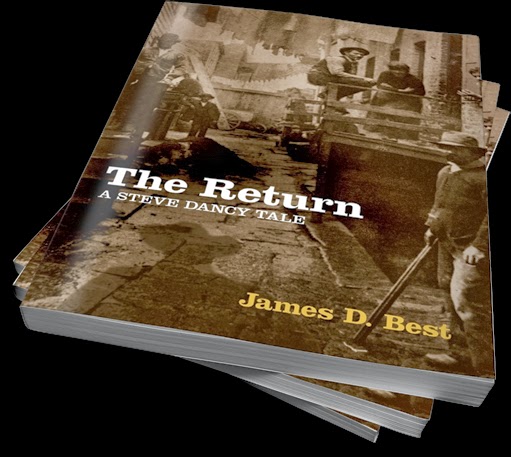
In the latest Steve Dancy Tale, The Return, Dancy and Sharp travel to see Thomas Edison in order to secure rights to his inventions for mining. In the research for the novel I discovered all kinds of interesting things about Edison, Menlo Park, New York City, and 1881 movers and shakers. I was also startled to discover that Edison owned mines and developed numerous patents that applied specifically to mining. It was difficult to avoid letting the Wizard of Menlo Park interfere with Dancy’s story. I succeeded by scrubbing the story during revisions and being conscious that this was a particular problem for me. I also used a technique that I’d like to add as a tip to Epstein’s Rules. At the end of the book, I added a “Historical Note.”  Through this device I was able to inform the reader about some historical tidbits without disturbing the flow of the story.

Related Posts

Friday, November 8, 2013

Yeah, this skit has it about right.

Many years ago, in what seems like a prior life, I wrote a nonfiction book on enterprise computing. At the time, I was a Chief Technology Officer for a Fortune 50 company. Since nonfiction is all about credentials, I had no trouble finding an agent and publisher. I was pretty happy. I had a Boston agent and Wiley & Sons as a publisher. This was going to be good.


I wanted to title my book Dinosaurs and Whippersnappers. I thought that would be a catchy title for a book about managing computer professionals. Unfortunately, my editor disagreed. In fact she disagreed with everything I wanted to write. She insisted that focus groups had determined that books with the word Digital in the title were in high demand. Against my wishes, she re-titled the book The Digital Organization. She also wanted the book to be about corporate America, insisting that I leverage my familiarity with a celebrity CEO. I also couldn't criticize any inane technology fad because Wiley had surely already published a book that claimed the craze would blow away all prior technology, reduce the corporate labor force by half, and eliminate childhood illness. 


None of this was good advice. By the time the book was eventually published, technologists were sick and tired of books with Digital in the title, my celebrity CEO had lost his luster, and all of my technology advice and references were woefully out of date. Business leaders, however, still had to manage computer professionals and my chapter on this subject kept the book alive in some MBA programs.

What brought all of this ancient history to mind? A hilarious skit by Mitchell and Webb. Way too close to my personal experience. Take a gander. 


The irony of all of this is that Wiley is still marketing The Digital Organization. Traditional publishing moves at a glacial pace, so this technology book was already obsolete by the time it hit bookshelves in 1997. Yet Wiley continues to offer a Kindle version for $49.95. Not many authors recommend against buying one of their own books, but I suggest you give this one a pass.

By the way, this experience taught me a lesson. Never write a book that has a shelf-life of six nanoseconds. This is a big reason why I write historical novels. They last forever. Even the contemporaneous books of Mark Twain, Jane Austen, Raymond Chandler, and Louisa May Alcott are now read as historical novels. I may not be of their caliber, but I sure want to write in their genre.

Friday, October 18, 2013

Mark Twain Tells Us How to Write

Mark Twain didn't like James Fenimore Cooper’s writing. Wait, that was far too mild of a sentence. In his article “Fenimore Cooper's Literary Offenses,” Twain ridicules, lacerates, and skewers Cooper.

Here’s a small sample: 
Cooper's art has some defects. In one place in "Deerslayer," and in the restricted space of two-thirds of a page, Cooper has scored 114 offenses against literary art out of a possible 115. It breaks the record. There are nineteen rules governing literary art in domain of romantic fiction -- some say twenty-two. In "Deerslayer," Cooper violated eighteen of them.

This 1895 article made me laugh out loud, but besides humor, I saw something else in the article. If all of the criticisms of Cooper were rewritten as positive statements, they would make a great guide to great writing. I believe this list can stand prominently next to Elmore Leonard’s Ten Rules of Writing.

So … with clemency from Twain, I present the "18 Commandments of Writing," by Mark Twain.

  1. A tale shall accomplish something and arrive somewhere.
  2. Episodes in a tale shall be necessary parts of the tale, and shall help to develop it.
  3. Personages in a tale shall be alive, except in the case of corpses, and that always the reader shall be able to tell the corpses from the others.
  4. Personages in a tale, both dead and alive, shall exhibit a sufficient excuse for being there.
  5. When the personages of a tale deal in conversation, the talk shall sound like human talk, and be talk such as human beings would be likely to talk in the given circumstances, and have a discoverable meaning, also a discoverable purpose, and a show of relevancy, and remain in the neighborhood of the subject at hand, and be interesting to the reader, and help out the tale, and stop when the people cannot think of anything more to say.
  6. When the author describes the character of a personage in the tale, the conduct and conversation of that personage shall justify said description.
  7. When a personage talks like an illustrated, gilt-edged, tree-calf, hand-tooled, seven- dollar Friendship's Offering in the beginning of a paragraph, he shall not talk like a Negro minstrel in the end of it.
  8. Crass stupidities shall not be played upon the reader by either the author or the people in the tale.
  9. Personages of a tale shall confine themselves to possibilities and let miracles alone; or, if they venture a miracle, the author must so plausibly set it forth as to make it look possible and reasonable.
  10. The author shall make the reader feel a deep interest in the personages of his tale and in their fate; and that he shall make the reader love the good people in the tale and hate the bad ones.
  11. Characters in a tale shall be so clearly defined that the reader can tell beforehand what each will do in a given emergency.
  12. Say what he is proposing to say, not merely come near it.
  13. Use the right word, not its second cousin.
  14. Eschew surplusage.
  15. Do not omit necessary details.
  16. Avoid slovenliness of form.
  17. Use good grammar.
  18. Employ a simple and straightforward style.

Great list, huh? Anyway, I’ll let Twain conclude this post with his conclusions about Cooper: 
I may be mistaken, but it does seem to me that "Deerslayer" is not a work of art in any sense; it does seem to me that it is destitute of every detail that goes to the making of a work of art; in truth, it seems to me that "Deerslayer" is just simply a literary delirium tremens. A work of art? It has no invention; it has no order, system, sequence, or result; it has no lifelikeness, no thrill, no stir, no seeming of reality; its characters are confusedly drawn, and by their acts and words they prove that they are not the sort of people the author claims that they are; its humor is pathetic; its pathos is funny; its conversations are -- oh! Indescribable;  its love-scenes odious; its English a crime against the language.
Counting these out, what is left is Art. I think we must all admit that.

Remind me never to get on the bad side of Twain. 

Wednesday, June 19, 2013

Fiction: art or craft?

You can buy innumerable books about how to write fiction. I have bookshelves full of them. Some help, but most are regurgitations of the same old stuff. The majority of these how-to books present a formulistic approach: If you get each of these elements right, you’ll have a bestseller. I beg to differ.

Storytelling
Neither too hard or too soft
I once bought three writing books simultaneously. The first was the bestselling text for college creative writing courses, the second was How to Write a Novel for Dummies, and the third was a middle-of-the -road advice book by a relatively successful novelist. The worst of the bunch was the college textbook which was all about mechanics and literary devices. Plot was reduced to paint-by-numbers. The Dummies book was a poor second. The actionable advice could have been adequately summarized on two typewritten pages. The middle-of-the-road book was by far the best of the breed and it has guided my book buying on writing from that point forward.

I’m biased. I believe storytelling is the most important aspect of fiction. Characterization is a close second, with plot a distant third. Literary devices are inconsequential until you have a compelling story.

There are great storytellers, great writers, and great storytelling writers. The first can be commercially successful, but eventually fade away. The second never gain a large audience. The third become immortal.

(Twain, Shakespeare, and Homer are but three examples.)

Raymond Chandler wrote, “all art at some time and in some manner becomes mass entertainment, and that if it does not it dies and is forgotten.” The secret to mass appeal is engaging stories. 

Fiction may be art or craft, but it is certainly not engineering.

Monday, March 18, 2013

Word-of-Mouth is Still King

Goodreads has completed a survey of their members about how they discovered books. They published the results at the link below.

Goodreads Survey


How do people discover what book to read? Unsurprisingly, word-of-mouth is still king. A recommendation from a trusted friend is the top answer, with "Everyone talking about it" in second place. The third most frequent answer: a book club recommendation. Since book clubs are made up of trusted fellow readers, I would add this answer to the word-of-mouth category. These three answers put together dwarf all of the other responses.


bestsellers bestselling
What does this mean for an aspiring author? One thing, and one thing only: write a good book. There are many out there who believe the trick is to jump on the next e-book marketing gimmick. That works ... but only for a brief period. People don't recommend or talk about shoddy books. If word-of-mouth is the #1, #2, and #3 best way to sell books, then authors need to write books that people want to share with friends. As Goodreads says, the survey pointed out "one powerful need: wanting to be connected with our 'tribe' through stories." 

So if you want to be an author instead of a digital huckster, write a good story, polish it to perfection, have it professionally edited and proofread, and then do it all again.