Showing posts with label thrillers. Show all posts

Sunday, August 18, 2019

Point of View Shift


Stories are told from a point of view (POV) and I prefer a predictable POV. Within a story, I find sudden shifts jarring.
Jarring bad, keeping the reader in the story good.
The most predictable POV is one that never changes throughout the course of the novel. All seven Steve Dancy Tales are written from Steve’s POV in first person. My Best Thrillers never change POV either, but the stories are told in third person. The advantage of a single POV is that the reader develops a closer relationship with the protagonist. Another plus is that the reader is pulled through the story at the same pace and with the same information as the protagonist, which helps the reader participate in the story.
A single POV doesn’t always help the story, however. In Tempest at Dawn, I alternate POV between Roger Sherman and James Madison. This allows me to portray the conflicts at the Constitutional Convention as the two warring camps strategize and maneuver against each other.
What brought all this to mind was an offer I recently made to give away one of my Steve Dancy short stories. (See the box to the top right.) When I was invited to write this short story for Wanted, A Western Story Collection, I decided to do something different with the project. Captain Joseph McAllen is a recurring character in the Steve Dancy Tales, but we never got inside his head. (You only read the thoughts of the POV character.) I thought it would be fun to tell this story from McAllen’s POV. I think it worked out well, but you can see for yourself by requesting the story.

Friday, June 28, 2019

New Review for the Shut Mouth Society


JackBoston.com has reviewed the Shut Mouth Society.  Read the full review here:

The Shut Mouth Society was a great and unexpectedly satisfying read. I’ve read several (not all) of Jim Best’s Steve Dancy novels and enjoyed them, but this novel is considerably more sophisticated and, well, interesting. Kind of like Russian Kachinka dolls, its setting is contemporary but within that it’s a historical novel. Like any historical novel, fact is married to fiction, and in this book it all works well together: the story carries the day and you don’t really know or need to care if every single thing is factual.


Monday, September 16, 2013

We can all learn from Shakespeare

Writer’s Digest did a piece titled, “10 Things Shakespeare Can Teach us About Writing Thrillers.” The ten tips actually help with any genre. Shakespeare was a great writer and a suburb storyteller. It’s the combination that makes him world renown nearly 400 years after his death. In his day, he was not a literary figure; he was the equivalent of a prime time screenwriter. Shakespeare wrote to fill theaters with paying audiences. (Somewhere around forty people depended on his plays for their livelihood.) 

Populist or Elitist?
One of my favorite writer quotes comes from Raymond Chandler; “It might reasonably be said that all art at some time and in some manner becomes mass entertainment, and that if it does not it dies and is forgotten.” 

Shakespeare is remembered because he aimed for mass entertainment. Shakespeare’s appeal to the general public is what makes these 10 writing tips powerful. All of them have to do with the storytelling side of his great talent. From an artistic standpoint, he was an unbelievably gifted wordsmith, but craft alone will not make a writer immortal. 

Nor, quite frankly, will storytelling divorced of good writing. Just ask Harold Robbins.


Related Posts

Monday, July 1, 2013

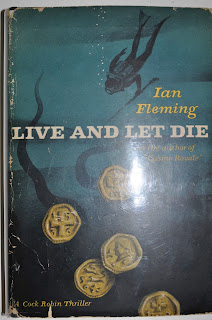
Full of Surprises—Live and Let Die by Ian Fleming

Ian Fleming

In high school, I read every Ian Fleming James Bond book. I liked them, but wasn't motivated to read them a second time until recently. I started with Live and Let Die, the second book in the series. The novel was full of surprises. I remembered that Bond was a different character than in the movies and the plots were less extravagant.  All true. James Bond is vulnerable and feels fear in the books. He is not as much of a loner and makes friends easily. The plot doesn't make sense in either the book or movie, but the action/escape scenes tend to the more realistic side in the novel. There is a fetish about equipment, but in the book, Bond is given somewhat specialized scuba gear, while in the movie, Roger Moore wears an electro-magnetic watch that can pull a wooden row boat by it metal rowlock. Fleming does not give Bond futuristic gadgetry. A steel-toe shoe is about as exotic as it gets.

Original book cover
First Edition Cover
Fleming was a much better writer than I remembered. His pacing was pitch-perfect and descriptions excellent. Although the dialogue often seemed pedestrian, Fleming was a great storyteller. Live and Let Die was an easy read, and there were more than a few times when I reread a section that showed skillful writing.


The big surprise was the racism reflected in this 1954 book. Fleming occasionally writes favorably about his black characters, but for the most part he relies on offensive words and stereotypes that were more generally accepted than we would like to remember. Fleming’s attempt to reflect black ghetto dialects seems crude and wrong. This novel demonstrates that racial attitudes have improved in the last sixty years. Perhaps everyone, especially the young, should read Live and Let Die to gain a fuller understanding of the 1950s.