Showing posts with label antagonists. Show all posts

Wednesday, January 15, 2014

Opposites Attract ... readers, viewers, and fans

Television series
Steed and Peel

Joe Bunting has a good article on literary foils at The Write Practice. Captain Kirk and Mr. Spock, John Steed and Emma Peel, The Lone Ranger and Tonto, Homes and Dr. Watson, Martin Riggs and Roger Murtaugh, Cole and Hitch, among many others. I’m inclined to favor a good buddy story over the lone protagonist. I even prefer James Bond when the rule-following CIA agent Felix Leiter is around.

Use literary foils to maintain tension when there are no bad guys within sight. As can be seen from these few examples, famous literary foils possess opposite personalities. That’s why on television cop shows, partners are contradictory. They can play off each other in any circumstance. This device makes it easy to generate low-key tension when the protagonists are disengaged from battling whatever has irked their ire.


Bunting correctly points out that literary foils can also be a love interest or an antagonist. When an antagonist is used as a literary foil, the relationship goes beyond rivalry. There’s an emotional tie between the two. In other words, the protagonist and antagonist are in a relationship. Homes’ long-running battles with Moriarty and Clarice Starling against Hannibal Lecter come to mind, but I’ve always been partial to Wile E. Coyote and the Road Runner.
western fiction
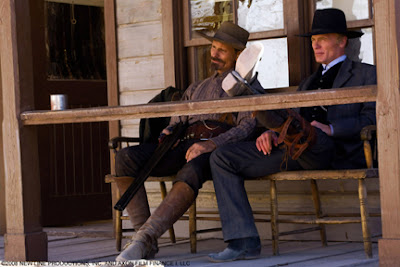
Cole and Hitch

Literary foils are an indispensable tool for writers. The Steve Dancy Tales is written in the first person, so without Jeff Sharp and Captain McAllen, it would be necessary to rummage around inside Steve head to get a feel for who he is and what he’s about. That would be boring. But with two contrary foils, Steve can interact with his friends and his personality is shown, not told. In The Shut Mouth Society, Greg Evarts and Patricia Baldwin are opposites in every conceivable way. The relationship makes it easier to keep the tension taut in this thriller.

There is an old saying that opposites attract. I’m not certain about life, but they certainly attract readers and viewers.

Friday, September 20, 2013

10 Writing "Rules" Western Authors Should Break

JR Sanders posted on Facebook for Western Writers of America an io9 article titled “10 Writing ‘Rules’ We Wish More Science Fiction and Fantasy Authors Would Break,” with a challenge to list Western rules that should be broken. At the risk of offending everyone, here is my unordered list.


1. Women portrayed only as prostitutes, schoolmarms, or long-suffering wives.
How about making a woman the villain? Or put a gun, reins, or a pen in her hand.
2. Homogeneous portrayal of American Indians
The culture of Indian tribes varied as much as Yankees and Southerners
3. Tombstone portrayed as a cattle town
Tombstone was a mining town. Everybody didn’t migrate west to chase errant cows or string barbed wire
4. Saloons portrayed as the sole entertainment in the West
Tombstone had ice crème parlors and a bowling alley. The Man Who Shot Liberty Valance made good plot use of a restaurant.
5. Gunfights portrayed as righteous, standup duels with the bad guy drawing first
Some researchers have concluded that most gunfights occurred within three feet.
6. Railroad tycoons portrayed as handy villains
This is such a cliché we’re ready to boo as soon as any railroad owner steps onto the page or screen.
7. Regular townsfolk and sodbusters portrayed as sniveling weaklings
These were pioneers, for goodness sakes. They wouldn’t have ventured west if they had no backbone.
8. Everyone in the West portrayed as dressing like cowboys
For example, miners wore squared toed boots and professionals and business owners wore suits.
9. The West portrayed as near childless
Kids are usually just props, but look how well breaking this rule worked for True Grit
10. The hero portrayed as riding off into the sunset.
I had fun with the end of The Shopkeeper by writing, “We rode out of Mason Valley with the sun at our backs."


Friday, May 24, 2013

3:10 to Yuma—Make and Remake


Western classics Glenn ford
Russell Crowe
I bought the original version of 3:10 to Yuma because I wanted to compare it with the Russell Crowe remake. I liked both. Crowe played a great bad guy, but Glenn Ford, normally cast as a good guy, appeared to enjoy playing a rogue. (3:10 to Yuma is now my favorite Glenn Ford movie.)

I won't discuss specifics, but there were several plot or character improvements in the new version, however, I preferred the ending in the 1957 film. In fact, the contrast in endings tells a lot about Hollywood’s reluctance to embrace traditional heroes. (Elmore Leonard's short story has yet another ending.)


Production values were certainly better in the later version. It's also fun to watch the two trailers back-to-back to see how selling movies has advanced in the last fifty years.


If you're a film student, movie enthusiast, or just like Westerns, both versions are great additions to a private library.

Tuesday, March 26, 2013

Author Interview by Tom Rizzo

Not too many posts lately because my brother is visiting from Hawaii and we're surfing everyday at Tourmaline Beach. My sister is also here, so the conversations go late into the night and I forget all about social media. Even my email is stacking up like two-by-fours at a lumber yard.

Tom Rizzo did a nice interview with me, so I took a few moments to post a link to his website.


Link to interview

"JAMES D. BEST likes to write what he calls “fish-out-of-water” stories. He has written six novels and a non-fiction technology book that he says “you don’t really want to buy.” Visit his website and he’ll tell you why. Jim has also served as a ghostwriter, a magazine columnist, and is an active blogger. Learn more about him, his stories, his thoughts on Westerns as historical fiction, and the key element needed for any successful novel."

Friday, November 16, 2012

Is Pinterest Good For Anything?

When I get stuck writing, I find myself wandering over to Pinterest. What is it about this site that's so fascinating?  First, it's visual, so it gives me a welcome mental break from words, words, words. Compared to other social sites, it's easier to tidy up and tinker with so it looks the way I want. 

Although I've heard some get addicted, I find Pinterest a quick sojourner that refreshes my mental state for writing. Pinterest is like a shoe box where I collect odd things that interest me. It  accommodates some of my quirky interests, like Great American Tacky, Slightly Ill Humor, or surfing.  

For example, I think villains are a key element of storytelling. Heroics can be uplifting, but heroes need someone or something to fight against. Nasty villains, allow heroes to be heroic.

If you'd like, you can check out my rogues gallery on Pinterest by clicking over to Bad to the Bone.