Showing posts with label #JamesBond. Show all posts

Monday, January 18, 2016

Steve Dancy Wants to be Pals with Jack Reacher


There have been some memorable fictional characters. Sherlock Holmes, James Bond, Hercule Poirot, and Harry Potter to name a few. (I’d like Steve Dancy to climb into this group, but I need a few million more sales. A little help, please.) The above names are make-believe people, but known the world over. How does a branded character come about? They must be difficult to create because there are so few of them. Strong characters are not rare. Think of Elizabeth Bennet, Tom Sawyer, Captain Ahab, Rhett Butler, or Hannibal Lecter. But for the most part, these were one-offs, while a branded character returns time and again, frequently leaping from the printed page to screen and stage.

The inventors of Holmes, Bond, Poirot, and Potter didn’t want for material things. Sherlock Holmes has been portrayed on screen more than any other character, and that excludes the House television series. Spanning 54 years, James Bond is the longest running film series with a human protagonist. (Godzilla is the longest and most prolific film series.) Agatha Christie used Poirot to propel herself to the #1 Bestselling author of all time, while Harry Potter is the #1 bestselling book series.

These are worldwide icons. Yet they’re fictional. They sprang from the imagination of authors. How in the world do you do that? One author has told us.

I recently reread Killing Floor by Lee Child. In a new introduction, Child describes how he developed the Jack Reacher character, who was introduced in this novel back in 1997.
“I liked some things, and disliked other things. I had always been drawn to outlaws. I liked cleverness and ingenuity. I liked the promise of intriguing revelations. I disliked a hero who was generally smart but did something stupid three-quarters of the way through the book, merely to set up the last part of the action.  Detectives on the trail who walked into rooms and got hit over the head from behind didn’t do it for me. And I liked winners. I was vaguely uneasy with the normal story arc that has a guy lose, lose before he wins in the end. I liked to see something done spectacularly well. In sports, I liked crushing victories rather than ninth-inning nail-biters. 
To me, entertainment was a transaction. You do it, they watch it, then it exists … for me the audience mattered from the start.
G. K. Chesterton once said of Charles Dickens, 'Dickens didn’t write what people wanted. Dickens wanted what people wanted.'"
Child sat down and came up with three specific conclusions.
"First: Character is king. There are probably fewer than six books every century remembered specifically for their plots. People remember characters … so my main character had to carry the whole weight.
Second conclusion: If you can see a bandwagon, it’s too late to get on … it’s a crowded field. Why do what everyone else is doing? … The series that were well under way … lead characters were primus inter pares in a repertory cast, locations were fixed and significant employment was fixed and significant. I was going to have to avoid all that stuff.
But the third conclusion, and the most confounding conclusion: You can’t design a character too specifically … a laundry list of imagined qualities and virtues would result in a flat, boring, cardboard character … I decided to relax and see what would come along. Jack Reacher came along.”
Child goes on to explain that Reacher has the following characteristics:
  • Fish-out-of-water because he had previously only known military life
  • He’s huge, utterly sure of himself, with intimidating presence (opposite of flawed protagonist)
  • Old-fashioned hero: no problems, no navel-gazing
  • Owns nothing but the clothes on his backliterally
  • No ties to family, friends or location
  • Ex-military cop to give him plausibility with investigative techniques
  • Rootless and alienated in a giant country (Child is British)
  • Reacher as Medieval knight-errant
  • First name is simple, ordinary, blunt, and straightforward
  • Certain nobility based on rank of major in military

Child wrote: “I wanted the kind of vicarious satisfaction that comes from seeing bad guys getting their heads handed to them by a wrong-righter even bigger and harder than them … so Reacher always wins.”

I started by asking, “How does a branded character come about?” It appears by creating a character unlike all the other series protagonists. Not a unique trait, but opposite in every detail. At least it worked for Reacher. A Forbes study discovered that Jack Reacher is the strongest branded character in fiction, and Lee Child has the strongest reader loyalty of any bestselling author.

Thursday, September 24, 2015

What makes a hero —Character or Activity?

Hollywood westerns film
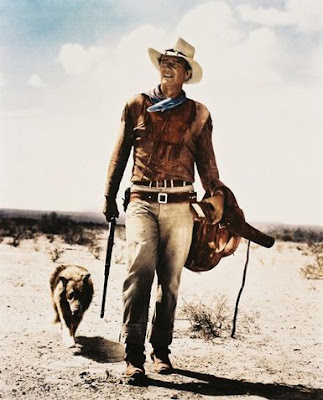
Hondo by Louis L'Amour

In 1949, Joseph Campbell published The Hero with a Thousand Faces. Campbell studied myths and stories down through the ages and came up with twelves steps in a hero’s journey, starting with normalcy or status quo and ending right back at status quo. The Matthew Winkler animated video illustrates Campbell’s definition of the journey. Campbell made a brilliant set of observations about the striking similarities of heroic sagas told throughout time and in every culture. (Steve Dancy complies with Campbell's theoretical journey.)


Campbell also breaks some new ground in describing the universal need for heroes, albeit in a language foreign to mortals.
The first work of the hero is to retreat from the world scene of secondary effects to those causal zones of the psyche where the difficulties really reside, and there to clarify the difficulties, eradicate them in his own case (i.e., give battle to the nursery demons of his local culture) and break through to the undistorted, direct experience and assimilation of what Jung called “the archetypal images.”
Say what?

The Hero With a Thousand Faces gives the impression that the journey itself makes the hero. It might be more accurate to say that anyone who prevails through all of the steps elevates himself or herself to heroic status. Most people retreat at Step One: Call to Adventure.


I believe heroism is more a question of character than events. Mark Twain agrees with me. He wrote:
“Unconsciously we all have a standard by which we measure other men, and if we examine closely we find that this standard is a very simple one, and is this: we admire them, we envy them, for great qualities we ourselves lack. Hero worship consists in just that. Our heroes are men who do things which we recognize, with regret, and sometimes with a secret shame, that we cannot do. We find not much in ourselves to admire, we are always privately wanting to be like somebody else. If everybody was satisfied with himself, there would be no heroes.”
Raymond Chandler also had a character-driven definition of a hero:
…down these mean streets a man must go who is not himself mean, who is neither tarnished nor afraid. He is the hero; he is everything. He must be a complete man and a common man and yet an unusual man. He must be, to use a rather weathered phrase, a man of honor—by instinct, by inevitability, without thought of it, and certainly without saying it. He must be the best man in his world and a good enough man for any world.
He will take no man’s money dishonestly and no man’s insolence without a due and dispassionate revenge. He is a lonely man and his pride is that you will treat him as a proud man or be very sorry you ever saw him.
The story is this man’s adventure in search of a hidden truth, and it would be no adventure if it did not happen to a man fit for adventure. If there were enough like him, the world would be a very safe place to live in, without becoming too dull to be worth living in.
Joseph Campbell is popular in academia, but perhaps it's possible to get a better description of a hero by asking one of those storytellers who have passed these tales down from one generation to the next.


Friday, May 8, 2015

Sherlock Holmes, James Bond, Hercule Poirot, and Harry Potter


The above names are fictional. Make-believe people known the world over. How does a branded character come about? They must be difficult to create because there are few of them. Strong characters, however, are not rare. Think of Elizabeth Bennet, Tom Sawyer, Captain Ahab, Rhett Butler, or Hannibal Lecter to name a few. But for the most part, these were one-offs, while a branded character returns time and again, frequently leaping from the printed page to the screen and stage.


A branded character can be literary, but more often he or she would be
more properly defined as well-crafted. After all, the prime attribute of a branded character is renown … and nothing common can be literary. (At least, that's the common wisdom, but some might disagree, like Shakespeare, Hawthorne, Austen, or Twain.)

There’s another characteristic of branded characters: they are enormously lucrative. The inventors of Holmes, Bond, Poirot, and Potter didn’t want for material things. I’m hoping that one day Mr. Dancy will be my meal ticket, but right now there’s another character hogging the limelight. Care to guess who’s today’s strongest branded character? Forbes chewed on the numbers and the winner is … Jack Reacher. It appears Lee Child has the strongest reader loyalty of any bestselling author.
I like Lee Child books, but personally prefer Stephen Hunter’s Bob Lee Swagger. You can’t argue with Child’s 70 million in sales. David Vinjamuri in Forbes writes, “But what’s most interesting about Lee Child’s creation is not the size of the brand but its strength. Child doesn’t have the largest following among bestselling authors: just over a third of book shoppers are aware of him versus the more than 95% who know John Grisham and the 99% aware of Stephen King, both of whom have sold more books. But while just under a quarter of Grisham and King’s readers count either man as their favorite author nearly a third of Reacher readers mark Child as their favorite.”

If you want to invent a branded character, I suggest reading the article. Vinjamuri provides some insight.