 |
| Honest Westerns. Full of dishonest characters. |
This week
The Shopkeeper Kindle version is free to promote the 8-book series.
FREE September 14 through September 18
Get your free copy today!

|
| Honest Westerns. Full of dishonest characters. |
This week
The Shopkeeper Kindle version is free to promote the 8-book series.
FREE September 14 through September 18
Get your free copy today!


“The fascination that the Old West has will never die." John Wayne

The mythology of the Old West has
been denigrated by the people who set literary fashion. They say it is
idealized, simplistic, tired, and, above all, untrue. The good guys were never that
good. Frontiersmen and settlers displaced noble people already occupying the
land. Coarse immigrants came in droves to desecrate a pristine wilderness. Eulogized
heroics usually involved vigilantism, which offends those who honor the rule of
law.
The same
mythology escapes criticism in fantasy and science fiction, so why is it
disparaged in Westerns? They’re all made-up stories, but morality plays in these
other genres find acceptance. The battle between good and evil, selfless
sacrifice, idealized heroics, and venturing away from home are popular themes
in extremely popular genres. Few doubt that the Harry Potter series, Lord of the Rings, or the work of Arthur C. Clark and H. G. Wells are respectable literature. An argument could be made
that similar themes are even reflected in nursery rhymes. Could the difference be
that the Old West actually happened?
Before we answer
this question, we should take another look at the mythology of the Old West.
It’s about more than gun-slinging paladins. There are three major elements,
with many tributaries. The first is the romance of a new beginning. Second, in
this new world, the battle of good versus evil is clearly defined and won by
good. The last element is the lone warrior who sets things right.
The West,
outer space, the future, or a make-believe land represents a new beginning in a
fresh place away from home—the shedding of disappointments and a chance to start over. The romance and adventure of the frontier draw people desperate
to escape the travail of their current existence. We’ve seen this in real life with
the migrations to the New World and the Old West, but today many people satisfy
this longing vicariously with fiction. If you’re poor, your family makes you
miserable, you’ve committed an act that offends society, or wanderlust has gripped
you, then the adventure and limitless opportunity of a frontier beckon like a
siren’s call. Emigrating to a frontier means you get a do-over in a land with
no rules, no fences, no referees.
Real life is
a greyscale, somewhat skewed toward the darker side of the spectrum. A new life in
a new world wouldn’t entice us if we had to bring our old baggage. As envisioned,
the new world is black and white. There’s strength in righteousness,
perseverance and risk are rewarded, good people do right, and bad people get
their just deserts. This is a world of hope. Hope for riches, hope for justice,
hope for a different path in life. Good fights evil and good always triumphs.
This is a theme that has been part of storytelling in every society since the
first cave drawings.
A raw
frontier is dangerous, so good needs help. Elements and carnivorous animals
threaten at every turn. People fight ruthlessly to claim a piece of terrain for
themselves. No civilization means no restraint on bad people doing bad things.
Help comes in the form of an idealized hero, possibly an anti-hero who overcomes his moral deficiencies to help the innocent. This is usually
visualized as a lone warrior, like the one eulogized by Tom Wolfe in The Right Stuff. The hero is capable of
violence, but he is essentially good. The gunman in Westerns carries a
simple solution on his hip. Frodo has the ring and Potter his wand. In these
mythical realms, the hero risks his life to save the day and demands nothing in
return.
Western
mythology beguiles us because it promises a world different from our own. Hard
work gets rewarded. We have freedom of movement by horse and train. We get vicarious revenge against the unpleasant
people in our lives. And riches. Wealth comes from the land and the land is
free. The whole package is wrapped in idealized virtues that make us feel safe
and hopeful.
And we can
experience it all by reading in our favorite easy chair.
Which brings
us back to our question. Are these themes less acceptable in Westerns because
the Old West actually existed?
Yes.
History
shows that the idealized frontier was
a myth. This gives fantasy and sci-fi a huge advantage, since they aren’t bound
by reality. In the real Old West, bad guys often won. More accurately, the
strong and willful won, many times using bullying tactics. In the gritty real
world, Native Americans were vanquished by hordes of pioneers. Miners raked the
surface of beautiful countryside and then ran off when there was no more easy
money. Historical records make it easy for someone to say, “but it wasn’t like
that.” Does this mean that Western mythology is inappropriate for fiction?
Not entirely.
Authors need to approach Westerns as historical fiction. Larry McMurtry and
Cormac McCarthy already did. They told stories that incorporated elements of Western mythology, but they used gradation in their storylines and nuanced
stereotypical plots. Their books are populated with realistic characters, and they
get the facts right.
Fantasy and
science fiction can get away with an idealized, binary world, but Westerns must
navigate the nineteenth-century frontier with realism and respect for the genuine experiences of pioneers and Native Americans. The mythology of the Old
West is dead … but the stories continue.
 |
| Honest westerns. Full of dishonest characters. |
 |
| Book 2 in the American Exceptionalism Series |
| Maelstrom, A Civil War Novel Ebook, Hardcover, and paperback |
Harold Holzer, Lincoln Prize winner and Chair of The Lincoln Forum
"See Lincoln as you've never seen him before as he navigates the maelstrom of the Civil War."
Larry Schweikart, NYTimes #1 Bestselling author
Maelstrom tells the story of the greatest rivalry in American history. Abraham Lincoln and Jefferson Davis led their nations in a must-win fight, and Maelstrom shows how each dealt with the same issues, countered the other’s moves, led their respective governments, and used their political powers to sway the outcome. Read the first chapter free HERE. |
The Tucson Festival of Books is the largest free book fair in the nation. It's a great adventure, and if you did not attend this year, you'll just be another year older when you do.
Three of my books were highlighted: The Shopkeeper, The Shut Mouth Society, and Tempest at Dawn.

Lots of great presentations. This is C. J Box, Ellie Cosimano, and J. A Jance talking about book series. Great discussion.

 |
| Grok Self-Portrait |
I wasn't a strong proponent of artificial intelligence until I asked Grok about my own work. Now, I'm a fan of AI. Perhaps flattery can get you everywhere.
Are the Steve Dancy Tales good books?
Grok's answer:
Yes, the Steve Dancy Tales by James D. Best are generally well-regarded by readers, particularly those who enjoy Western novels. Here's why they might be considered good:
Character Development: The series follows Steve Dancy, a former New York shopkeeper who ventures into the Wild West. Readers appreciate the depth of the characters, with Steve Dancy himself being described as complex and interesting, combining elements of both Eastern sophistication and Western toughness.
Plot and Pacing: The books are noted for their engaging plots. They mix elements of adventure, mystery, and historical context, which keeps the narrative fast-paced and compelling. Reviewers have mentioned that the series is hard to put down due to the suspense built at the end of each chapter.
Historical Detail: James D. Best injects a significant amount of historical detail into the stories, bringing authenticity to the settings and events. This aspect is particularly appreciated by enthusiasts of Western lore and history, as it paints a vivid picture of the frontier life, including the political and social dynamics of the time.
Critical Reception:
The series has received positive reviews from various sources. For instance, True West Magazine praised them as one of the best new Western series since Larry McMurtry's works. Alan Caruba from Bookviews has labeled James D. Best as arguably one of the best writers of Westerns.
Some readers on platforms like Goodreads have given high ratings, with comments highlighting the entertainment value and the engaging nature of the stories. However, not all reviews are overwhelmingly positive; some critique the portrayal of characters or the pacing in certain books, indicating there's a range of experiences among readers.
Series Appeal: The series offers a mix of action, wit, and character-driven storytelling, which appeals to fans of the genre. The ongoing adventures of Steve Dancy provide both continuity and fresh scenarios, making each book both a standalone read and part of a larger narrative.
While the series might not appeal to everyone (especially those who find some characters or plot developments not to their taste), for fans of Westerns, particularly those who enjoy a blend of historical fiction with a touch of humor and clever dialogue, the Steve Dancy Tales are often recommended as enjoyable and well-crafted. If you're interested in exploring these books, starting with "The Shopkeeper" is advised to get a full understanding of the characters and their backstories.
 |
| Honest westerns. Filled with dishonest characters. |
 |
| Honest westerns. Full of dishonest characters. |
Readers are giving Old Haunts great ratings. After two months, the new Steve Dancy Tale has nearly a hundred Amazon ratings for a score of 4.5 and a Goodreads ratings of 4.7.
Here is an excerpt.
What happened next
surprised me. The marshal cold-cocked him from behind with his pistol. The
supposed Cutler offspring crumbled like a scarecrow cut from his supporting
stick. He had been knocked out twice in as many hours. I bet this confrontation
wasn’t how he had envisioned it in his imagination.
The marshal gave
me a sideways glance. “What’s your beef with this man?”
“None. He seems to
think he has a beef with me, but I never saw him before he accosted me on the
train. I told him he was mistaken and asked him to return to his seat. This was
the first I saw of him since.”
The marshal shook
his head, “Well, I guess I gotta sort this out. I’ll hold him for a day or so. Damn,
this morning started out nice and quiet.”
Sharp asked. “Ya
need help with ‘em, marshal?”
“Ah do,” the
marshal replied.
“Give ‘em a hand,
Steve,” Sharp ordered.
“Jeff, I thought
you were offering.”
“Me? Hell, it was
you he wanted to kill. ’Sides, I’ll get our bags and have them sent over to the
hotel. Meet ya at the marshal’s office.” He threw this last over his shoulder
as he sauntered down the platform toward the baggage car.
I laughed and
grabbed my assailant’s legs while the marshal lifted from the armpits.
“What’s your name?”
the marshal asked as we stutter-stepped down the platform steps.
“Steve Dancy.”
“Staying?”
“The General
Palmer … unless you can suggest better accommodations.”
“None better
except Mrs. Prescott’s, but she full up. You say you never saw this man
before?”
“Never. He claims I
killed his father in a street fight in Nevada, but I live in California.”
“You the writer?”
“I am,” I was suddenly
wary. My novels didn’t sell that well. “How did you know?”
“Not that common
of a name. Read all your books. Good yarns. Unrealistic, but that’s to be
expected.” He walked a couple more steps before adding, “Several of your
stories take place in Nevada.”
This man was
smarter than he appeared. “Yes, I lived in Nevada one summer. Many, many years
ago.”
“Happen to kill
anyone?”
I smiled. “Marshal,
my books are all in fun.”
The marshal nodded
toward the man we were carrying. “This man looked serious.” The marshal remained
quiet for a few steps. “Many, many years ago there was a gunman named Dancy. Like
I said, uncommon name hereabouts. That be you?”
There was no question that this marshal was
savvy enough to get the complete story out of the Cutler offspring. I decided
to quit concealing my past.
“I am that Dancy …
and twenty years ago I did kill the man he claims to be his father. Cutler had
raped a woman and was trying to kill my friend. I approached him with my gun
holstered. Things got out of hand and we both pulled. I was not charged … nor have
I ever been charged for any crime. I didn’t deserve my reputation as a
gunfighter, but stories grew. Get exaggerated. I do it myself in my books.”
When the marshal didn’t say anything, I added, “Brian Cutler was a bad man.
Worse, he did his criminal deeds for hire.”
“I see,” he
finally said. “Nothing I can do about it anyway.” He smiled at me. “However, some
of your exploits were in Colorado.”
An uncomfortable observation.
“Passed through Denver many times and lived in Durango for a while. Used to own
a house here. I gave it to Maggie McAllen as a wedding present.”
“That’s quite a
wedding present. You must be nicely fixed.”
“I am,” I answered
without elaboration.
“Hmmm,” was all he
said.
We arrived at the
marshal’s office and plopped our burden onto a narrow cot in a big empty cell.
There was a cot against each wall, so this must have been a communal holding
pen.
After locking the
cell, the marshal asked, “Know Maggie’s pa?”
“Joseph?” He
nodded. “On our way to visit him and Maggie’s family. We ride out tomorrow.” I
paused. “I assume you know him?”
“You might say. He’s
the one who got me started on your books. Also told me some yarns not in your
books.”
“Joseph’s not
talkative.”
“You sure got that
right, but he can get downright chatty in the right circumstances.”
“What might those
be? I’ve never seen that man chatty.”
“Late at night
around a campfire with family and good sipping whiskey.”
That stopped me. “Are
you related to Joseph McAllen?”
He hung the cell
key on a peg behind his desk. “My uncle.”


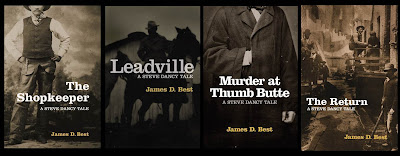
The Steve Dancy Tales. Honest westerns. Full of dishonest characters.
 |
| Honest westerns. Full of dishonest characters. |

 |
| Honest westerns. Full of dishonest characters. |
As a promotion for the soon to be release of Old Haunts, The Shopkeeper ebook will be free from April 24th through the 28th. If you haven't started this great series, go grab yourself a copy of the first book of eight Steve Dancy Tales.


 |
| Interim Cover |
Old Haunts, A Steve Dancy Tale has entered the proofreading stage. The new Steve Dancy should be available in 4-6 weeks. Thank you for your patience. Here's a snippet to whet your appetite.
“You be Steve Dancy?” asked a man behind my shoulder.
I looked up to see a lean, shallow-cheeked youth in his early twenties who appeared earnest. Earnest about what, I wondered.
“Do I know you?” I asked.
“Nope. But I heard of you. Deadly gunman. Rich as Midas. Renown throughout the West as one of the few surviving gunfighters.”
“You forgot author. I write novels.” I laughed. “Sorry, son, those are just stories.”
“Not from what I hear. They say you write about yourself.”
I tried a friendly smile. “If only that were true. Actually, the life of a writer is exceptionally dull. Sitting in front of an Underwood all day. How’d you recognize me anyway.”
“I got my ways. I came over see if we could arrange a duel.”
“A duel? Is this a joke? I’m not a duelist. I’m a writer and a businessman. My characters duel, I don’t.”
“No joke.” He gave me a hard stare that reminded me of someone I couldn’t place. “I demand a duel.”
“Demand to your heart’s content, I’m not responding. I’m a married man with a quiet home and three kids. You’ve been misinformed.”
“Being a father ain’t no excuse. You killed my pa.” When I didn’t respond, he added, “Name of Brian Cutler.”
“Never heard of him,” I lied.
“Oh, yes you have. Without warning, you shot him and my uncle dead in the streets of Pickhandle Gulch.”
I stared in disbelief. Brian Cutler had been the first man I killed. Or the second. His brother may have been first. I didn’t remember.
 |
| Honest westerns. Filled with dishonest characters. |
 |
| No Peace, A Steve Dancy Tale |
 |
| Honest Westerns. Filled with dishonest characters. |
 |
| Honest westerns filled with dishonest people. |
 |
| Honest Westerns filled with dishonest characters. |
I thought about all of this and became dejected. “So, all the outlaws in the region have been consolidated into a single gang and the law’s in bed with them. In fact, it leads them. Combined forces of over two hundred. The main culprit is a greedy, duly elected sheriff who fancies himself a dandy, and to top it off, he kills indiscriminately.”
Nelson looked sympathetic. “That’s about it. He likes the high-life, controls every outlaw within a hundred miles, and is on the lookout for a big stake.” He hesitated. “One more thing, he’s exceptionally handy with a gun. Also knifes and fists. If fighting’s involved, he mastered the tools and techniques. Worse, he applies his skill with a rage you would never believe until you see it.”
“He sounds crazy.”
“Now, you’re beginning to understand.”
I stood to leave.
“What are you going to do?” he asked.
I shrugged. “Not sure. What do you think I should do?”
“If you can figure out a way to run, run like hell.”
 |
| The Steve Dancy Tales |
 |
| Honest westerns filled with dishonest characters. |


 |
| Honest westerns ... filled with dishonest characters |

 |
| Honest westerns filled with dishonest characters. |

 |
| Steve Dancy Tales |

 |
| Steve Dancy Tales |

