 |
| The story of the greatest rivalry in American History. |
Showing posts with label abraham lincoln. Show all posts
Showing posts with label abraham lincoln. Show all posts
Monday, June 1, 2026
Sunday, April 26, 2026
Maelstrom now available
 |
| Book 2 in the American Exceptionalism Series |
| Maelstrom, A Civil War Novel Ebook, Hardcover, and paperback |
“I enjoyed this.”
Harold Holzer, Lincoln Prize winner and Chair of The Lincoln Forum
"See Lincoln as you've never seen him before as he navigates the maelstrom of the Civil War."
Larry Schweikart, NYTimes #1 Bestselling author
Maelstrom tells the story of the greatest rivalry in American history. Abraham Lincoln and Jefferson Davis led their nations in a must-win fight, and Maelstrom shows how each dealt with the same issues, countered the other’s moves, led their respective governments, and used their political powers to sway the outcome. Read the first chapter free HERE. |


Thursday, March 23, 2023
The Myth of the Lost Cause Vs. The Real Lincoln

This post deals with two books on the “Lost Cause.”
Thomas J. DiLorenzo presents the case for the Lost Cause in
The Real Lincoln: A New Look at Abraham Lincoln, His Agenda, and an UnnecessaryWar, while Edward H. Bonekemper argues against the Lost Cause in The Myth ofthe Lost Cause: Why the South Fought the Civil War and Why the North Won.
What is the Lost Cause? The basic tenants are as follows:
the War of Northern Aggression had nothing to do with slavery; the South did
nothing to provoke war; the Constitution included a right to secede and the
South should have been allowed to leave peacefully; antebellum life in the
South was prosperous, dignified, and just; slavery was already dying; Robert E.
Lee deserved deification, U. S. Grant deserved demonization, the North deserves
condemnation for engaging in total war; the South had no chance of winning, and
most important of all, Lincoln was a despot who started the war by invading
South.
Basically, the Lost Cause is innocence unjustly victimized.
I chose these two specific books because they are both relatively
recent (2003 and 2015) and each author presents their respective positions
clearly, with entertaining gusto. On which side of this controversy did I land?
You can probably guess, but this argument has raged for over one hundred and
fifty years and these books will provide all the information you need to make
up your own mind.
(These are research books for Maelstrom, a sequel to Tempestat Dawn.)
Monday, August 15, 2022
Desperate Engagement by Marc Leepson
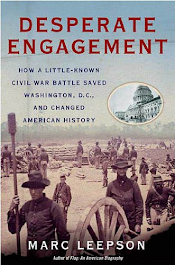
A lot happened between July 9th and the 12th in 1864. Marc Leepson has made this short period of the Civil War the focus of his book Desperate Engagement: How a Little-Known Civil War Battle Saved Washington D. C., and Changed American History.
In the end, the battle changes little other than perhaps delaying the end of the war. General Grant continued his stranglehold on the Confederate Army surrounding Richmond until Lee surrendered at Appomattox. Nonetheless, if the Hail Mary pass had been completed and General Jubal Early had sacked Washington, we might be all speaking with a Southern accent.
It was close. Heart-stopping close.
The risky moves and countermoves, potential payoff, and unbridled heroism on both sides should have made this an exciting book. The Battle of Monocacy and attempted siege are nicely covered in about four or five chapters with the remaining chapters filled mostly with letters and memoirs of the participants, asides, or research factoids. Civil War buffs should find even the trivia interesting, but a casual reader might view much of this text as fill.
Thursday, July 21, 2022
Abraham Lincoln, by Lord Charnwood

Lord Charnwood published Abraham Lincoln in 1916. In order
to get a clearer perspective of the Civil War, it helps to read books from
multiple viewpoints. Lord Charnwood wrote only fifty years after the war,
bringing an almost contemporaneous perspective to his depictions. His biography
has the advantage of proximity but with enough time elapsed to dampen the
passions of the moment. More important, as an English depiction, it is a
simultaneously a distant point of view. It is a distance of more than nautical
miles. Lord Charnwood also brings the bias of English nobility to his
descriptions. This is exceptionally important in gaining an understanding of
the diplomatic imperative for both sides. The Confederacy desperately sought
European recognition of their legitimacy, while Lincoln did everything in his
power to deny international recognition and suppress arms and funding from
abroad. Lincoln’s success was arguably pivotal to eventually making victory
possible.
Abraham Lincoln, by Lord Charnwood can be a tough read. A
simple, declarative sentence is beyond the baron. This is partly due to the
style of the times and partly the way of academics who feel a need to qualify
every utterance. Once the reader adjusts to the wordily writing, nuggets of
rare perspective make the effort well worthwhile. For example, Thomas Jefferson
is not one of my favorite Founders and Lord Charnwood seems to have shared some
of my reservations. He also makes other political observations that an American
might be reluctant to express.
If you have an interest in the mid-nineteenth century,
Abraham Lincoln by Lord Charnwood can be an enlightening read.
Monday, March 14, 2022
LAND OF LINCOLN: ADVENTURES IN ABE'S AMERICA by Andrew Ferguson
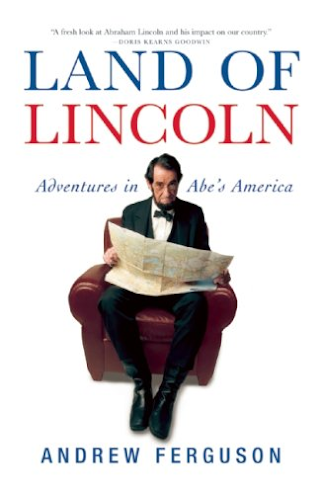
This is a fun memoir of a modern-day search for the real
Abraham Lincoln. In childhood, Andrew Ferguson had been a Lincoln buff but had
developed other interests in adulthood. The enigmatic and “shut-mouth” Lincoln
provided pundits an open field for speculation. As a result, a plethora of
interpretations have been tossed around that purport to explain his
personality, beliefs, motivations, administration, family, and even sexual
orientation. Glorifying tributes stand beside hate filled censures. Ferguson trekked
across the country to get a fix on the man. He traversed the Lincoln Heritage
Trail with his family, visited major and not-so-major memorials, interviewed
Lincoln collectors, gawked at Lincoln impersonators, and talked to guides,
academics, and park rangers. Lincoln remained elusive, but Ferguson’s wit and
lively writing style kept the quest entertaining and educational … although the
reader may learn more about modern-day Americans than they learn about our
sixteenth president.
Tuesday, April 30, 2013
Judging a Book by Its Cover
 |
| February, 27, 1860 |
The Shut Mouth Society is a contemporary thriller about a
conspiracy that goes back to Abraham Lincoln. The novel was published in 2008,
which happened to be the Lincoln Bicentennial. It opens with Lincoln's
Copper Union address on February 27, 1860, prior to his nomination for
president. On the same day, he had a photograph taken by Mathew Brady.
(Lincoln claimed the Copper Union address and Brady photograph made him
president.) A book cover that used this photograph would tie into both the novel's
introduction and the Bicentennial. My designer came up with a unique close-up cropping
that really showed Lincoln’s intelligence and determination. I thought it
couldn’t miss.
Big miss. Sales were lackluster and customer
reviews on Amazon and Goodreads were mediocre to scathing. Sales were hurt by an
avalanche of nonfiction books released to take advantage of the bicentennial,
and early buyers of The Shut Mouth Society assumed it was another book about Lincoln.
A few even bought it because they assumed it was nonfiction. Although the story did include extensive Lincoln history, the novel was a modern-day chase thriller in which the
protagonists desperately try to unravel a one hundred and fifty year old
conspiracy.
I could have given up on the book, but The Shut Mouth Society was a finalist for Best Novel in the Glyph Awards, and it had received excellent
reviews in the general press. We decided to try another cover design. You
can see both of them side by side below.


The new cover worked miracles. Sales
increased dramatically and customer reviews were effusive. At the time of this
writing, the book has 161 Amazon reviews for 4.3 stars, and 491 ratings on
Goodreads for 3.7 stars. I’m pleased with the Goodreads numbers because the newer rankings had to overcome dismal early returns.
Nothing changed but the book cover.
Nothing changed but the book cover.
Why am I bringing this up now? Because we’re in the final throe
of designing a book cover for The Return, A Steve Dancy Tale. We had many concept mock-ups,
but I rejected many of them because despite being nice graphically, they didn’t
fit the story. I learned my lesson. Covers build reader expectations. This is
why genre covers look alike. They’re designed to appeal to an audience that
will appreciate the book. So don't believe the cliché that people should never
judge a book by its cover. People do.
Insist on a well-designed cover that fits your storyline.
Insist on a well-designed cover that fits your storyline.
Thursday, January 26, 2012
Faith Friese Nelson Reviews The Shut Mouth Society
.jpg)
The Shut Mouth Society by James D. Best is the kind of book I like
best.
It
starts with a rich collector who has discovered an early Abraham Lincoln
document. The collector asks two people to authenticate the manuscript: Greg
Evarts, a detective, and Patricia Baldwin, a professor. The professor, of
course, is not only smart but stinking rich and beautiful. The novel has
everything from intrigue and murder to romance.
The
story begins in California and progresses to the historical east coast where
the reader is introduced to private libraries, secret apartments, and shown how
rich and powerful civil war descendants live. Conspiracies and secret societies
from the Civil War era are unveiled in such a realistic manner that, when I
finished the book, I actually did some research to separate fact from fiction.
Wednesday, October 19, 2011
Mr. Madison Writes a Letter to Mr. Jefferson

Read the full article
Friday, August 12, 2011
New Cover for The Shut Mouth Society
For a long time, I've wanted to change the cover of The Shut Mouth Society . Although the story has strong historical elements, it's a contemporary thriller. The old cover looked like a historical novel, or even a non-fiction book on Lincoln. With the completion of Murder at Thumb Butte
 , I was able to dedicate some time to work with a designer on a new cover.


. Although the story has strong historical elements, it's a contemporary thriller. The old cover looked like a historical novel, or even a non-fiction book on Lincoln. With the completion of Murder at Thumb Butte, I was able to dedicate some time to work with a designer on a new cover.

Tuesday, September 14, 2010
Helping with a book report
I received an email note from a student asking for help on a book report on The Shut Mouth Society. Here are the questions and my responses.
Were did you spend your childhood?
 In southern California. Although I lived in Torrance, I spent, or misspent, my youth in Hermosa Beach surfing.
Why did you write the Shut Mouth Society?
Why did you pick President Lincoln?

. Here are the questions and my responses.Were did you spend your childhood?
 In southern California. Although I lived in Torrance, I spent, or misspent, my youth in Hermosa Beach surfing.
Why did you write the Shut Mouth Society?
My first novel was Tempest at Dawn, a historical novel about the 1787 Constitutional Convention. I was researching a companion book about Lincoln's political leadership during the Civil War, and discovered that Mary Lincoln had supposedly burned all of Lincoln's papers before they left for Washington. It got my imagination going. What if new pre-presidential Lincoln papers were found? Why had they remained hidden? How could I make a mystery out of it? One day I started writing, and a bit over a year later, The Shut Mouth Society was sent to editing. I'm still working on a Lincoln book that will take place in the mid-nineteenth century.
Why did you pick President Lincoln?
I write historical novels, but my special interest is the Constitution. After Tempest at Dawn, I felt the next most important Constitutional event in history was the Civil War because slavery had been left unresolved during the Constitutional Convention. I also find Abraham Lincoln a fascinating character, which is crucial in storytelling.
Why do you write about history?
I love history. It's the story of mankind. Also, I want to write books with a long shelf-life. My first book was non-fiction about computer technology. The publishing industry moves slow, so the book was technically obsolete before it hit the bookstores. A historical novel can last forever.
Were did you get your education?
I got an undergraduate degree in economics from California State University at Northridge, and an MBA from UCLA
What awards have you received?
I don't generally submit my work for awards, but The Shut Mouth Society was a finalist for the ABPA Glyph Award for "Best Popular Fiction." Although not an award, Tempest at Dawn was featured on The Glenn Beck Show and is on the Glenn Beck Reading List and the Constituting America Reading List.
.jpg)
.jpg)
Friday, August 27, 2010
Lincoln at Cooper Union

In early 1860,
Abraham Lincoln was a little known regional politician from Springfield,
Illinois. The Republican Party was new, and had failed running national hero
John C. Frémont for president in 1856. Abraham Lincoln chances of ascending to
the presidency under the Republican banner were slight. All that changed in New
York City on February 27, 1860. That afternoon, Lincoln had his photograph
taken by Mathew Brady, and in the evening, he gave a historic speech at the
Cooper Union. Lincoln often said that Brady’s photograph and his Cooper Union
address propelled him to the presidency.
Below is a highly abridged
version of Lincoln’s speech.
“We hear that you
will not abide the election of a Republican president! In that event, you say
you will destroy the Union; and then, you say, the great crime of having
destroyed it will be upon us!
“That is cool. A
highwayman holds a pistol to my ear, and mutters through his teeth, ‘Stand and
deliver, or I shall kill you and then you will be a murderer!’
“What the robber
demands of me—my money—is my own; and I have a clear right to keep it; but my
vote is also my own; and the threat of death to me to extort my money and the
threat to destroy the Union to extort my vote can scarcely be distinguished.”
“What will convince
slaveholders that we do not threaten their property? This and this only: cease
to call slavery wrong and join them in calling it right. Silence alone will not
be tolerated—we must place ourselves avowedly with them. We must suppress all
declarations that slavery is wrong, whether made in politics, in presses, in
pulpits, or in private. We must arrest and return their fugitive slaves with
greedy pleasure. The whole atmosphere must be disinfected from all taint of
opposition to slavery before they will cease to believe that all their troubles
proceed from us.
“All they ask, we
can grant, if we think slavery right. All we ask, they can grant if they think
it wrong.
“Right and wrong is
the precise fact upon which depends the whole controversy.
“Thinking it wrong,
as we do, can we yield? Can we cast our votes with their view and against our
own? In view of our moral, social, and political responsibilities, can we do
this?”
The hall burst with
repeated shouts of “No! No!”
“Let us not grope
for some middle ground between right and wrong. Let us not search in vain for a
policy of don’t care on a question about which we do care. Nor let us be
frightened by threats of destruction to the government.”
Prolonged applause
kept Lincoln silent for several minutes before delivering his final sentence.
“Let us have faith
that right makes might, and in that faith, let us, to the end, dare to do our
duty as we understand it!”
When Lincoln stepped
back from the podium after this dramatic conclusion, the Cooper Union Great
Hall exploded with noise and motion. Everybody stood. The staid New York
audience cheered, clapped, and stomped their feet. Many waved handkerchiefs and
hats.
If you want to see
how a principled politician gained national repute with honor and integrity, I recommend Lincoln at Cooper Union by Harold Holzer. You might also enjoy the Lincoln historical theme I used in my contemporary thriller, The Shut Mouth Society.
Wednesday, October 1, 2008
The Shut Mouth Society at the Kentucky Book Fair

I'm pleased to have been invited to participate in the Kentucky Book Fair. http://kybookfair.org/
The central purpose of the Kentucky Book Fair is to bring writers and patrons together in celebration of their mutual interest and to promote awareness of the importance of writing and reading. The Book Fair uses proceeds from the Fair to benefit causes associated with the promotion of reading and writing.
The Kentucky Book Fair, now in its 27th year, is a one-day event, held this year on Saturday, November 15, 2008. The event takes place in Frankfort, the state’s Capitol City. The focus of the 2008 Kentucky Book Fair will be Abraham Lincoln because his bicentennial occurs on February 12, 2009 and Kentucky was the state of his birth.
Although the invitation was based on The Shut Mouth Society, I'll be signing all my books. Over two hundred authors are confirmed, so this is going to be a large and exciting event. If you like to talk to authors or other people interested in writing, this is going to be a great place to meet people.
I hope you can make it.
http://www.jamesdbest.com/
http://www.stevedancy.com/
Subscribe to:
Posts (Atom)