Showing posts with label Lincoln. Show all posts

Thursday, July 21, 2022

Abraham Lincoln, by Lord Charnwood


Lord Charnwood published Abraham Lincoln in 1916. In order to get a clearer perspective of the Civil War, it helps to read books from multiple viewpoints. Lord Charnwood wrote only fifty years after the war, bringing an almost contemporaneous perspective to his depictions. His biography has the advantage of proximity but with enough time elapsed to dampen the passions of the moment. More important, as an English depiction, it is a simultaneously a distant point of view. It is a distance of more than nautical miles. Lord Charnwood also brings the bias of English nobility to his descriptions. This is exceptionally important in gaining an understanding of the diplomatic imperative for both sides. The Confederacy desperately sought European recognition of their legitimacy, while Lincoln did everything in his power to deny international recognition and suppress arms and funding from abroad. Lincoln’s success was arguably pivotal to eventually making victory possible.

Abraham Lincoln, by Lord Charnwood can be a tough read. A simple, declarative sentence is beyond the baron. This is partly due to the style of the times and partly the way of academics who feel a need to qualify every utterance. Once the reader adjusts to the wordily writing, nuggets of rare perspective make the effort well worthwhile. For example, Thomas Jefferson is not one of my favorite Founders and Lord Charnwood seems to have shared some of my reservations. He also makes other political observations that an American might be reluctant to express.

If you have an interest in the mid-nineteenth century, Abraham Lincoln by Lord Charnwood can be an enlightening read.

Saturday, May 7, 2022

Grant Takes Command by Bruce Catton


When asked, what sort of man is Grant, Lincoln replied that Ulysses S. Grant was “the quietest little fellow you ever saw. The only evidence you have that he’s in any place is that he makes things git! Wherever he is, things move.

Lincoln explained that every other general briefing him before a battle told him that he was short some crucial resource to ensure victory, but, if ordered, they would proceed anyway. This essential resource was almost always cavalry. Lincoln claimed their real purpose was to shift responsibility to him. When Grant took charge, he immediately recommended reassigning twenty thousand horseless cavalrymen to the infantry. Since there was no way to acquire horses for every man designated as cavalry, these idle soldiers were only held in reserve as a handy excuse. Grant recognized the duplicity and removed the excuse before his first battle.


In this biography, Bruce Catton does an excellent job describing the man and his military philosophy. Grant reminded me of General Patton, a warrior through and through. Both believed that to decrease casualties in war, you don’t minimize the fallen in a specific battle, you win the war to stop the killing.

Catton relates a story about a grizzled sergeant leaning against a fence post when a comrade came up.  The sergeant jerked a thumb at a man in the distance and remarked: “That’s Grant. I hate to see that old cuss around. When that old cuss is around there’s sure to be a big fight on hand.”

Sunday, February 27, 2022

The Lincoln Myth by Steve Berry


When writing a historical book, sometimes you need a recess from hard history. I thought The Lincoln Myth by Steve Berry would provide an appropriate break. Instead of relaxing, I found the book annoying. The Lincoln Myth interlaces Mormon history and a trendy premise about Abraham Lincoln into a modern-day thriller. The premise probably came from The Real Lincoln by Thomas J. DiLorenzo, a popular 2009 book that contended that the South had a right to secede, and the Civil War was unnecessary. DiLorenzo went further stating that eliminating slavery was not a goal of the conflict and only afterwards used as a justification. I believe this premise an over-simplification, but I’ll postpone explaining why until I review The Real Lincoln.


What drew me to the book was the Lincoln and Constitution history interwoven into the story. I wrote my own Lincoln mystery/thriller (The Shut Mouth Society) and a novelization of the Constitutional Convention (Tempest at Dawn), so I found it jarring to read Madison’s convention notes and finding material I knew wasn’t present. Berry had a viewpoint with little evidence to support that his viewpoint was correct, so he altered existing documentation and invented entirely new documentation. I objected less to the invented documentation because it disappeared with a novelist sleight of hand. Perfectly legitimate. Altering Madison’s notes, however, seemed lazy and unnecessary to support his plot. Berry was making a political point by modifying the historical record. If omitted, the plot could have moved along the same path without a jarring interruption that defiled Madison's notes.

 As a thriller, The Lincoln Myth succeeds but not as well as Berry's other novels.

Saturday, January 29, 2022

A Tale of Two Antagonists


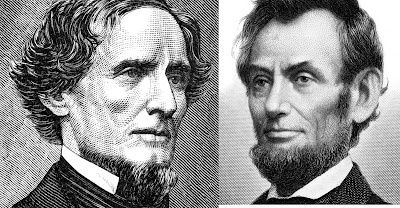
Abraham Lincoln and Jefferson Davis were interesting characters. Exactly the type of characters a novelist needs to carry a story.

In writing Maelstrom, I had a scene where Lincoln addresses Congress after a recess. (As customary at the time, his address was read by a clerk.) Not much has happened during the recess. Eleven states had seceded from the Union, Fort Sumter had been bombarded and surrendered, a piece of Virginia had been occupied, and Lincoln had exceeded his executive powers to spend unauthorized money, build an army, and suspend habeas corpus among other things.

He desperately needed Congress to backfill behind him.

This was a crucial address. Important for Lincoln and the country. The address was not one of his well-known speeches, but I was struck by the clarity and simplicity of the explanation of why he took these actions.

Lincoln said it was a struggle for maintaining a form of government “whose leading object is to elevate the condition of men—to lift artificial weights from all shoulders—to clear the paths of laudable pursuit for all—to afford all an unfettered start, and a fair chance in the race of life.”

I cannot think of a loftier goal for government.