Showing posts with label criticism. Show all posts

Monday, October 29, 2018

Sisters Brothers—The Movie


Joaquin Phoenix and John C. Reilly

This weekend I saw Sisters Brothers. I write westerns, so I’m critical of Hollywood ventures into the genre. They often mess it up by leaning toward the politically correct or destroying the story with CGI. This time they got it right. The Sisters Brothers is a good western film worthy of the fine novel by Patrick deWitt. That’s saying a lot. Except for Lonesome Dove, most directors view a book as a loose guide, rather than a roadmap. (hint, hint)

Great Cover
The Sisters Brothers is a character study ... and a study of not particularly admirable characters. The appeal is in the dialogue and humor. Thankfully, there are few special effects to take the viewer away from the story. I might be tempted to think Hollywood has learned a lesson, but I suspect this is a one-off because the novel’s author is Canadian and the film’s director French. Leave it to foreigners to revitalize an American genre. Jacques Audiard keeps the film within the spirit of the novel and directs a true western without relying on grandiose landscapes, unhistorical duels, or CGI. He does include a lot of killing, however. After all, the Sisters Brother are assassins.

The film is rated 85% at Rotten Tomatoes. 

Here is the New York Times review.

Owen Gleiberman, Variety’s Chief Film Critic seemed more interested in virtue signaling than critiquing the movie, but here is his review as well. I find Gleiberman’s review interesting because it displays many of the biases which keep Hollywood from making more good Westerns.

Wednesday, September 11, 2013

Book Reviews—The good, the bad, and ...

western fiction

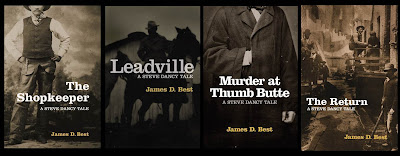
There are no ugly book reviews only good and bad reviews.  At least that would be true under the axiom that any publicity is good publicity. The Return, A Steve Dancy Tale recently received one of each. Let’s start with the good.

Bookviews by Alan Caruba is one of my favorite book blogs. Caruba is a writer by profession and a longtime book reviewer. In his review of The Return, he puts me in the same paragraph with Elmore Leonard. That alone puts Bookviews into my favorite column, even if Caruba hadn’t already reviewed most of my other books. He writes: “James D. Best … is arguably one of the best writers of westerns.” Those are kind words, and I appreciate them. You’ll find Caruba’s review of The Return in his September Picks of the Month.


On the other hand, at Brandywine Books, Lars Walker writes, “The Return, another Dancy story, is another well-written tale,” but adds, “it turned me off the series, not because of the writing, but because of one of the themes.” It seems Mr. Walker was offended by Dancy's interaction with his snobbish mother. He writes, “Steve’s ability to defy her through premarital cohabitation is presented as a sort of moral triumph.” A good observation, but I feel obligated to support my characters despite their failings. You can read Walker’s review of The Return by clicking on this link.

The Return, A Steve Dancy Tale has also received some nice reviews by Amazon Readers.

Western fiction
Steve Dancy Tales

Wednesday, August 28, 2013

The Telegraph talks about the future of Westerns


David Gritten has written a perceptive and informative article in the U.K. Telegram about the future of Westerns. It is titled, "Is it high noon for western films." 

Gritten doesn't think so. Neither do I. In fact, I believe Westerns are at the beginning of a rebirth. Here is an example of why I think this way. Google Elmore Leonard and the listings invariably reference only his crime novels. Western enthusiasts know he was one of the great Western authors, but apparently few in the media are aware of this fact. The Pacific Standard recently published a somewhat snarky article about how Elmore Leonard began his writing career pumping out cowboy stories, but transitioned to his award winning crime novels after demand dwindled for Western fiction. This line is repeated endlessly in articles eulogizing Leonard upon his recent death. His move from Westerns to crime was almost four decades ago. No one in the media seems to have noticed that more recently, bestselling crime novelist Robert B. Parker ended his memorable career by writing a highly successful Western series about hired guns Virgil Cole and Everett Hitch. 

I could list more indicators of a resurgence in Westerns, but the bigger question is why supposed arbiters of popular culture are so intent on tamping down the Western every time a cowboy hat rises above the ridgeline? Why do they sound gleeful that The Lone Ranger flopped? (Actually, The Lone Ranger grossed $88 million in theaters, which would be respectable for a reasonably budgeted film.)

A simple answer is that most of the media critics live along the eastern seaboard and don’t relate to Westerns or even the vast wilderness that lies beyond the Hudson River.  But there must be more. Hollywood and publishing gatekeepers support the same stories and themes in fantasy and science fiction. It’s okay to wield a magic wand or a precious ring, but not a six-shooter? Outer space aliens can be killed with abandon, but not bad guys in black hats. I’m not sure what the answer is, but there seems to be a prevailing fear that the Western may once again become popular with the general public. If anyone has an answer as to why Westerns offend the elite, I would sure like to hear it.

Sunday, August 18, 2013

Academic Nonsense about the American West


Looking for literary critiques of Western literature, I accidentally came across the article “Westerns” by Nicolas S. Witschi in Oxford Bibliographies. Witschi is Professor of English at Western Michigan University, where he teaches literature, cultural studies, and film. Sounds like some fun subjects. His website boosts, “My book Traces of Gold argues for reading the history of literary realism in the American West as a figurative engagement with the material, economic, and cultural value of natural resource industries.”


Wow! I was stopped by figurative engagement. In fact, I was stopped dead in my tracks as I stuggled to figure out what this showy sentence meant. Witschi was trying to convey a message, but instead of comprehending, I was Googling academic jargon. It reminded me of the line in Planes, Trains & Automobiles when the character Neal Page tells Del Griffith, "And by the way, you know, when you're telling these little stories? Here's a good idea - have a POINT. It makes it SO much more interesting for the listener!"

The article reads no better. Witschi seems to recommend studying Western literature as a sort of anthropological investigation of American culture. Although, it's hard to tell with sentences like, “As for questions about ‘literary’ quality and complexity, recent critical methodologies have not only expanded the criteria for assessing such things to include artifacts of mass market or popular appeal; they have also brought to light, with the purpose of working against it, the very means by which discursive power functions to identify and separate.” That’s as clear as the night sky over Montana.

The breadth of Western literature is astounding. From James Fenimore Cooper to Larry McMurtry, authors have been writing compelling historical novels about the American frontier. I’ll accept negative academic criticism of the Western genre as soon as I read a piece that dismisses The Once and Future King by T. H. White as mythology that promotes conquest, vigilantism, and sexism. Instead of searching for tidbits that can be extrapolated into a doctoral thesis, perhaps Witschi’s literature and film students would benefit from reading Westerns to learn the art and craft of storytelling.