Wednesday, July 17, 2013

Ink Tank does: The 8 sexiest cowgirls to kiss John Wayne

John Wayne was a lucky man. As the leading man in 142 films, he had the honor of working with somewhere near 142 leading ladies. Ink Tank does a fun job of selecting "The 8 sexiest cowgirls to kiss John Wayne."

Steve Dancy Tales
Steve Dancy Tales

Tuesday, July 16, 2013

Empires of Light: the story of a fascinating feud in the Wild East


During the time of America's Wild West, there was also a wildness in the civilized East. It wasn't a range war; it was ruthless combat on the frontier of science. Telegraphs and trains compressed time and space, engines and motor gave man super strength, and electricity expanded day into night. These were parlor tricks that burst out of the laboratories to the wonder of a bustling nation. It was near magic, and hard-nosed men fought to control these supernatural enterprises.

Jill Jonnes in Empires of Light: Edison, Tesla, Westinghouse, and the Race to Electrify the World does an excellent job of helping us understand the energy and competitiveness of the time. The "War of the Electric Currents" was an exciting part of our history that could have been made dull as mud. Jonnes avoids tedious explanations of technology to tell the story through three men: Thomas Edison, Nikola Tesla, and George Westinghouse. The supporting cast includes robber barons that provided money and intrigue. It was a Wild East fighting over a vast business frontier without rules, fences, or referees.


In researching my latest book, I read, or seriously scanned several books on Edison and one on Tesla. I picked up the Jonnes' book because I wanted a better understanding of Westinghouse. Jonnes does a good job of presenting all three key players in the "War of the Electric Currents." Empires of Light is especially good if you want a single book that puts this fascinating feud into perspective. She makes these giants human and shows that they had distinct personalities. Empires of Light is a nicely done, balanced history book about a world-shattering period of invention and innovation.

Thursday, July 11, 2013

The Lone Ranger—Hi-Yo Silver Away!

The Lone Ranger has ginned up a lot of controversy. It’s not a homage to the 1950s television series, nor should it be. Reinvigorating the Western genre means appealing to younger generations. Other than costumes, do the Batman films have anything to do with the television series? Well, in the Lone Ranger, they even ditched the costumes. Thank goodness, because a masked man in a form-fitting white outfit made as much sense on the range as Roy Roger’s blinged cowboy shirts. The movie appropriately retained only the symbolic white hat.

Purists criticize the film for enlarging the role of Tonto over the Lone Ranger. I disagree. The television series and the film are buddy stories and good buddy stories need parity between the partners. The film comes closer in this regard than the old Clayton Moore/Jay Silverheels series. To me, this had more of the flavor of the Lethal Weapon series—a bomance disguised with irreverent bantering.


Bottom line: I liked The Lone Ranger. I laughed out loud, which is rare for me inside of a movie theater. I was dazzled by some of the cinematography, and loved the score. The characters were different than I expected, but struck me as fresh. The plot follows the standard story line of a wronged protagonist reluctant to accept the mantle of hero. That’s behind us now, so from this point forward, it’s Hi-Yo Silver Away!

If you’re interested in some other perspectives, take a gander at these:


Monday, July 8, 2013

Owen Wister’s Virginian Would not Approve

women pioneers
Poor, but smiling nonetheless

Last month, Paul Mountjoy of Virginia wrote a snarky article for the Washington Times website titled, “The Old West: When men were men and women knew their place.” He opens with the following paragraph. 
“How many times have we heard men declare of the days of the old West, ‘men were men and women stayed at home and knew their place’? This is a common refrain after folks watch a movie based on the period.”
How many times? None, that I've encountered. This is not a common refrain of Western film enthusiasts. It is a writer’s cheap trick. Attribute a sexist comment to something you intend to denigrate.

Mountjoy proceeds to make commonplace observations about the true nature of gunfights in the Old West, list everyday hardships as if they were unique to the frontier, and reminds us that people died of disease and attacks without good medical assistance. The West, of course, was completely void of compassion due to men “witnessing 25 thousand deaths in a matter of days” during the Civil War. (I'm sure this callousness never afflicted men in the actual battleground state of Virginia.) Mountjoy has a penchant for hyperbole. He also claimed prostitutes in the West took “up to 50 or more customers nightly, more often than not, in an alley between two buildings.”

Perhaps Mountjoy’s motive is to promote employment for his friends in the nation’s capital. He writes, “If their farmer husband became disabled and had no older sons to take over the farm, they were in deep trouble. There were no government programs to help.” That seals it; the real Old West was nothing like the movies. And I thought White House Down was a documentary.

Mountjoy misses the whole point of Western mythology. I wrote an article titled, “Is the Mythologyof the Old West Dead?” Here's one paragraph. 
“The West, outer space, the future, or a make-believe land represents a new beginning in a fresh place away from home—the shrugging off of disappointments and a chance to start all over again. The romance and adventure of frontiers draws people desperate to escape the travail of their current existence. We've seen this in real life with the migrations to the New World and the Old West, but today many people satisfy this longing vicariously with fiction. If you're poor, your family makes you miserable, you've committed an act that offends society, or wanderlust has gripped you, then the adventure and limitless opportunity of a frontier beckons like a siren's call. Emigrating to a frontier means you get a do-over in a land with no rules, no fences, no referees.” 

It’s the absence of civilization that draws stalwart people to a frontier. They can start over and build a better life. Maybe they won’t, but they’re willing to take risks just for the chance. Listing hardships never dissuaded pioneers, whether they were setting off for Plymouth or Tombstone. They were a tough and hopeful breed. We lament the demise of the frontier and the Old West because we need more of these courageous people.


Sunday, July 7, 2013

Coming Soon ... The Return, A Steve Dancy Tale

western fiction
Friday, I signed the final approval forms for The Return, A Steve Dancy Tale. Whew!


western fiction
The Return by James D. Best


I wish that meant the book was done and the novel would be available next week. Lots yet to do for the print version and formatting remains for ebooks. Turnaround for ebook formatting is generally quick, so I expect both formats to be available within the next four weeks. Perhaps a little sooner. Center Point's Large Print version will come out the first quarter of 2014. The movie has been green-lighted for 2024, or thereabouts.


Friday, July 5, 2013

Eat, Drink, Read, and be Merry

We had a great 4th of July with friends, hamburgers, and noodle salad. Breaking bread with friends is one of the pleasures in life. I think it goes back to campfires and caves, when you savored eating instead of being eaten.

Reading Steve Dancy Tales
Bookbar, Denver


Books can be friends, as well. That’s why I liked this Flavorwire article on “10 Literary Restaurants for Hungry Book Nerds Around the World.” I think I’ll put all 10 on my bucket list.

If you believe reading and food go together, you’ll enjoy Book Eats, a blog dedicated to food and books.


Wednesday, July 3, 2013

An Elixir for a Frenzied Pace

The world keeps moving faster. I used to do email once a day, but people kept getting irritated that I took twenty-four hours to respond. The assumption is that everyone has a smart phone and is checking email continuously. Not me, although I do check it about three times a day now.

James D. Best
The Good ol' Days

Sometimes I fail to answer the phone. When I follow up, the caller asks in an accusatory tone where I was. Nowadays, people expect to get hold of anyone at their convenienceespecially bosses. When you run to Starbucks from work, you need to remember to grab your cell phone off your desk or face angry stares when you return. We’re supposed to be wired at all times.


In this age of Big Data, we are getting our information in snatches. News magazines have given way to tweets. The crawl at the bottom of the screen tears your attention away from the larger story coming from the anchors. You can’t even relax while watching entertainment television because you need to have the remote handy to speed past the commercials.

Deep breath. It’s summer. Relax. Find a good book, a sand chair, and turn off the world. Take a mini-vacation with a good story. Travel to another place and time without leaving your backyard. You’ll be surprised how much you can recharge with an hour to yourself.

I’m breathless just writing this. I think I’ll go to the movies tonight and heed the admonishment not call, text, surf, or use telepathy during the screening.


May I suggest one of these.


Monday, July 1, 2013

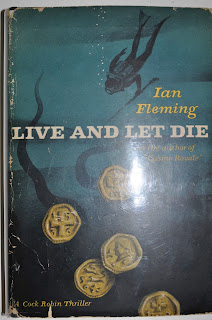
Full of Surprises—Live and Let Die by Ian Fleming

Ian Fleming

In high school, I read every Ian Fleming James Bond book. I liked them, but wasn't motivated to read them a second time until recently. I started with Live and Let Die, the second book in the series. The novel was full of surprises. I remembered that Bond was a different character than in the movies and the plots were less extravagant.  All true. James Bond is vulnerable and feels fear in the books. He is not as much of a loner and makes friends easily. The plot doesn't make sense in either the book or movie, but the action/escape scenes tend to the more realistic side in the novel. There is a fetish about equipment, but in the book, Bond is given somewhat specialized scuba gear, while in the movie, Roger Moore wears an electro-magnetic watch that can pull a wooden row boat by it metal rowlock. Fleming does not give Bond futuristic gadgetry. A steel-toe shoe is about as exotic as it gets.

Original book cover
First Edition Cover
Fleming was a much better writer than I remembered. His pacing was pitch-perfect and descriptions excellent. Although the dialogue often seemed pedestrian, Fleming was a great storyteller. Live and Let Die was an easy read, and there were more than a few times when I reread a section that showed skillful writing.


The big surprise was the racism reflected in this 1954 book. Fleming occasionally writes favorably about his black characters, but for the most part he relies on offensive words and stereotypes that were more generally accepted than we would like to remember. Fleming’s attempt to reflect black ghetto dialects seems crude and wrong. This novel demonstrates that racial attitudes have improved in the last sixty years. Perhaps everyone, especially the young, should read Live and Let Die to gain a fuller understanding of the 1950s.