Showing posts with label 1950s. Show all posts

Monday, July 1, 2013

Full of Surprises—Live and Let Die by Ian Fleming

Ian Fleming

In high school, I read every Ian Fleming James Bond book. I liked them, but wasn't motivated to read them a second time until recently. I started with Live and Let Die, the second book in the series. The novel was full of surprises. I remembered that Bond was a different character than in the movies and the plots were less extravagant.  All true. James Bond is vulnerable and feels fear in the books. He is not as much of a loner and makes friends easily. The plot doesn't make sense in either the book or movie, but the action/escape scenes tend to the more realistic side in the novel. There is a fetish about equipment, but in the book, Bond is given somewhat specialized scuba gear, while in the movie, Roger Moore wears an electro-magnetic watch that can pull a wooden row boat by it metal rowlock. Fleming does not give Bond futuristic gadgetry. A steel-toe shoe is about as exotic as it gets.
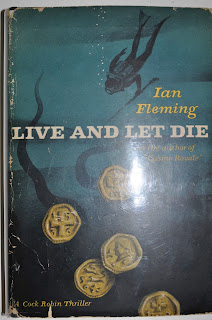
Original book cover
First Edition Cover
Fleming was a much better writer than I remembered. His pacing was pitch-perfect and descriptions excellent. Although the dialogue often seemed pedestrian, Fleming was a great storyteller. Live and Let Die was an easy read, and there were more than a few times when I reread a section that showed skillful writing.


The big surprise was the racism reflected in this 1954 book. Fleming occasionally writes favorably about his black characters, but for the most part he relies on offensive words and stereotypes that were more generally accepted than we would like to remember. Fleming’s attempt to reflect black ghetto dialects seems crude and wrong. This novel demonstrates that racial attitudes have improved in the last sixty years. Perhaps everyone, especially the young, should read Live and Let Die to gain a fuller understanding of the 1950s.

Sunday, December 2, 2012

Authors Acting Badly Toward Other Authors

Jack Kerouac
Truman Capote


Writing as contact sport.

"That's not writing, that's typing."—Truman Capote to Jack Kerouac

"The world is rid of him, but the deadly slime of his touch remains."—John Constable about the death of Lord Byron

"Every word she writes is a lie, including 'and' and 'the.'"—Mary McCarthy about Lillian Hellman

"If he really meant what he writes, he would not write at all."—Gore Vidal about Henry Miller

"I am fairly unrepentant about her poetry. I really think that three quarters of it is gibberish. However, I must crush down these thoughts, otherwise the dove of peace will shit on me."—Noel Coward about Dame Edith Sitwell

"He had a mind so fine that no idea could violate it."—T. S. Eliot about Henry James

"She was a master at making nothing happen very slowly."—Clifton Fadiman about Gertrude Stein

"The stupid person's idea of the clever person."—Elizabeth Bowen about Aldous Huxley

"To those she did not like she was a stiletto made of sugar."—John Mason Brown about Dorothy Parker

"To me Pound remains the exquisite showman without the show."—Ben Hecht about Ezra Pound

"His verse is the beads without the string."—Gerard Manley Hopkins about Robert Browning

"He is mad, bad and dangerous to know."—Lady Caroline Lamb about Lord Byron

"Nothing but old fags and cabbage-stumps of quotations from the Bible and the rest, stewed in the juice of deliberate, journalistic dirty-mindedness."—D. H. Lawrence about James Joyce

"He writes his plays for the ages - the ages between five and twelve."—George Nathan about George Bernard Shaw

"Virginia Woolf's writing is no more than glamorous knitting. I believe she must have a pattern somewhere."—Dame Edith Sitwell about Virginia Woolf

"A great zircon in the diadem of American literature."—Gore Vidal about Truman Capote

"The only genius with an IQ of 60."—Gore Vidal about Andy Warhol

"He is able to turn an unplotted, unworkable manuscript into an unplotted and unworkable manuscript with a lot of sex."—Tom Volpe about Harold Robbins