Showing posts with label literary devices. Show all posts

Wednesday, November 20, 2019

Book Review -- How Literature Works by John Sutherland


50 key concepts for writing fiction

John Sutherland is a literary critic and columnist for the Guardian. The sub-title of his book is "50 Key Concepts" and it's organized into 50 4-page chapters. Fancy that. I read a couple books a year on writing and occasionally read books on literary criticism. Literary criticism tomes tend to be esoteric and assume the reader already has broad knowledge about the subject. Sutherland's book is concise and written in clear English any layman can understand. I read these books to improve my writing and most of the time I need to wade through lengthy jargon-laced verbiage to find nuggets that are helpful. Sutherland's clarity, short chapters, and headings make this task relatively easy. I find what I'm looking for or move on to the next chapter.

If you're a writer, reader, or like to study literary criticism, How Literature Works is a fun find. Besides, most academic books on the subject require a new mortgage while Sutherland's perfect-bound paperback is only $11 on Amazon. The Kindle version is $9.50.

If you're interested in writing, be sure to check out my Writers and Writing pages on this blog.

Wednesday, January 15, 2014

Opposites Attract ... readers, viewers, and fans

Television series
Steed and Peel

Joe Bunting has a good article on literary foils at The Write Practice. Captain Kirk and Mr. Spock, John Steed and Emma Peel, The Lone Ranger and Tonto, Homes and Dr. Watson, Martin Riggs and Roger Murtaugh, Cole and Hitch, among many others. I’m inclined to favor a good buddy story over the lone protagonist. I even prefer James Bond when the rule-following CIA agent Felix Leiter is around.

Use literary foils to maintain tension when there are no bad guys within sight. As can be seen from these few examples, famous literary foils possess opposite personalities. That’s why on television cop shows, partners are contradictory. They can play off each other in any circumstance. This device makes it easy to generate low-key tension when the protagonists are disengaged from battling whatever has irked their ire.


Bunting correctly points out that literary foils can also be a love interest or an antagonist. When an antagonist is used as a literary foil, the relationship goes beyond rivalry. There’s an emotional tie between the two. In other words, the protagonist and antagonist are in a relationship. Homes’ long-running battles with Moriarty and Clarice Starling against Hannibal Lecter come to mind, but I’ve always been partial to Wile E. Coyote and the Road Runner.

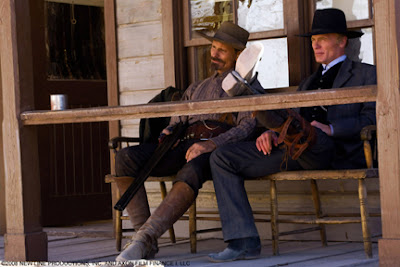
western fiction
Cole and Hitch

Literary foils are an indispensable tool for writers. The Steve Dancy Tales is written in the first person, so without Jeff Sharp and Captain McAllen, it would be necessary to rummage around inside Steve head to get a feel for who he is and what he’s about. That would be boring. But with two contrary foils, Steve can interact with his friends and his personality is shown, not told. In The Shut Mouth Society, Greg Evarts and Patricia Baldwin are opposites in every conceivable way. The relationship makes it easier to keep the tension taut in this thriller.

There is an old saying that opposites attract. I’m not certain about life, but they certainly attract readers and viewers.

Friday, June 21, 2013

Would You Care for a Slice?

I don’t believe there are only seven basic stories types, or that all stories are about “a man goes on a journey or a stranger comes to town.” Stories span a long continuum, with hard reality at one end and pure fantasy at the other.

One of the categories used to describe stories is slice of life. This moniker means the story describes mundane events that could happen to anyone. This is where literary authors shine. Great writing is supposed to make slice of life fiction engaging and enlightening.

Illustrators have always worked with storytellers

This kind of thinking has sent many aspiring authors down a path to oblivion. In truth, there are no pure slice of life books. At least, not any successful ones. Look at Little Women, To Kill a Mockingbird, The Help, The No. 1 Ladies' Detective Agency, or anything by Jane Austen. These books may seem mundane or low key on the surface, but the authors are expert storytellers. Take The No. 1 Ladies' Detective Agency as an example. Most of Ramotswe’s cases are mundane to the point of being inconsequential, but the investigations are as suspenseful as any Agatha Christi murder. To Kill a Mockingbird and The Help artfully reveal courage in commonplace social situations. Little Women often seems autobiographical, but Louisa May Alcott knew when to deviate from her real life to keep the story interesting. Austen kept her readers engaged with suspense, characterization, and dialogue, all vital tools for storytellers.

People don’t live in the rhythm of a story. Everything that happens does not move an individual’s life toward a conclusion. People do not consistently spout clever lines. Writers put those words in their mouth. Writers scrape off all the boring stuff from everyday life. And writers move the story unfailingly forward.

To keep readers captivated, study the art of storytelling. 

Wednesday, June 19, 2013

Fiction: art or craft?

You can buy innumerable books about how to write fiction. I have bookshelves full of them. Some help, but most are regurgitations of the same old stuff. The majority of these how-to books present a formulistic approach: If you get each of these elements right, you’ll have a bestseller. I beg to differ.

Storytelling
Neither too hard or too soft
I once bought three writing books simultaneously. The first was the bestselling text for college creative writing courses, the second was How to Write a Novel for Dummies, and the third was a middle-of-the -road advice book by a relatively successful novelist. The worst of the bunch was the college textbook which was all about mechanics and literary devices. Plot was reduced to paint-by-numbers. The Dummies book was a poor second. The actionable advice could have been adequately summarized on two typewritten pages. The middle-of-the-road book was by far the best of the breed and it has guided my book buying on writing from that point forward.

I’m biased. I believe storytelling is the most important aspect of fiction. Characterization is a close second, with plot a distant third. Literary devices are inconsequential until you have a compelling story.

There are great storytellers, great writers, and great storytelling writers. The first can be commercially successful, but eventually fade away. The second never gain a large audience. The third become immortal.

(Twain, Shakespeare, and Homer are but three examples.)

Raymond Chandler wrote, “all art at some time and in some manner becomes mass entertainment, and that if it does not it dies and is forgotten.” The secret to mass appeal is engaging stories. 

Fiction may be art or craft, but it is certainly not engineering.