Showing posts with label #SteveDancy. Show all posts

Thursday, August 24, 2017

Center Point Has Published Crossing the Animas in Large Print


Center Point will publish a hard bound, large print version of Crossing the Animas, A Steve Dancy Tale. They’re a great group of people, so I signed the contract immediately. 

I’m thrilled that Center Point will have published all six of the Steve Dancy novels. It also pleases me that the first five books earned past their advances. That probably explains why Center Point bought the large print rights to Crossing the Animas. That’s a compliment I feel really good about.

Look for Crossing the Animas in your local library. Trade paperback and ebook formats are also available.


Honest westerns filled with dishonest characters.

Thursday, May 4, 2017

The Evolution of a Big Diehl Book Cover


Book covers are a big deal. People really do judge a book by its cover. The Steve Dancy Tales always use black and white photos with only my name in color. For those who follow this blog, you already know my son designs my covers. (I joke that I'm getting his pricy art school tuition back one book cover at a time. In truth, his billing rate to real clients makes me embarrassed to ask him to do yet another cover.)

For Crossing the Animas we picked a great photo by William Diehl. Admittedly, this is a modern photograph, but the subject matter is vintage. Here is the original photo and resulting cover side by side. It may look simple, but there's craft in the cropping and lettering.


railroads photography

We didn't just select this photo on a whim. Here are some of the concepts covers we considered.

design

The construction of Denver & Rio Grande line between Durango & Silverton plays a key role in the story, and Diehl's iconic photograph fit the plot perfectly.

If you like trains, the Old West, or just great photography, visit the William Diehl website. Here are a couple more samples of his art.


Tuesday, April 18, 2017

Crossing the Animas, A Steve Dancy Tale

Crossing the Animas is available for the Kindle. The print format will along shortly. Center Point plans to publish the large print library edition early in 2018. No contract has been established for an audio version, but I'm sure that will come along later this year.


“Ben Law is tough… and mean. He enjoys taking care of problems for his boss. He won’t just verbally assault you. He and his men will hurt you. Bad.”
Steve Dancy is about to find this out. With his new home in Durango, Colorado, the kind with a nice white picket fence, and marriage on the horizon, the last thing Dancy wants is trouble.  Especially with a mining tycoon and his henchmen. But this is the frontier … and sometimes a feud finds you. Sometimes, it even chases you. When the quarrel endangers Dancy’s fiancĂ©e and friends, he has no choice but to fight.
And this is a fight Dancy must win.


P.S. Evidently Crossing the Animas is so new that searches may not turn it up. You can go directly to the product page here.


Wanted II, a collection of seven western short stories, is now available for Kindles. The paperback version will be along shortly. Try six western authors for only $2.99. You'll discover I have good company on these pages.


Don't forget about the recent release of the audio version of Jenny's Revenge. Even if you already read it, listening can double the pleasure.


I'm also writing three essays this year for Constituting America. This is a great site about the founding of our country. My first essay on Home Building & Loan v. Blaisdell (1934) has been published here. I'll let you know when the other two become available. Both are due by May 1, which looks pretty close. As the famed author, Douglas Adams said, "I love deadlines. I love the whoosing sound they make as they go by."


Wednesday, April 12, 2017

A New Steve Dancy Short Story

Wanted II is now available for pre-order at Amazon. Again, the book includes a Steve Dancy short story. This was a fun one for me. Steve is traveling by horseback from San Diego to Los Angeles when he's attacked by highwaymen. Grab a copy. At $2.99, the ebook is a great bargain with short stories by some of the best western writers of our day. Present company included, of course.


Tuesday, February 7, 2017

Crossing the Animas back from Editor


A few days ago, my editor sent me the edited version of Crossing the Animas and related files. I'm anxious to reviewed her revisions, but I have some personal issues which require me to be in northern California.

Here is the remaining process to publication. Next, I go through every revision, one at a time. I do this to approve the change and improve my writing skill. After I have a clean edited manuscript, the book goes to my ebook formatter. He makes sure the book looks good on various ereaders. My proofreader gets at crack at the book next.

In the past, I published the print and ebook versions simultaneously. The world has changed. Now, more than 90% of my sales are electronic versions of the book. (Excluding library large print sales) So the ebook versions will be published without waiting for the longer print book process.

All of this means that the ebook version of Crossing the Animas should be available before the end of March. The print version will follow about sixty days later.

I hope you enjoy it.

Rough Cover Option

Sunday, March 13, 2016

My Second Short Story

I write novels. Seven and counting. (Plus six nonfiction books, if I include my ghost writing assignments.) I’ve previously written only one short story, for which I received an Honorable Mention as a finalist. Maybe that didn’t count. It was a newspaper contest for a one hundred word novel. In the beginning, I thought anyone could string together one hundred words, but it took me a week to create a draft fit for submittal. Short is hard.

All of this is preface to telling you that I have written my first real short story. “Snake in The Grass” is a Steve Dancy Tale with a twist. I won’t tell you the twist. You have to read it for yourself. Where? First, you’ll need to wait a few months. The book is an anthology written by seven top selling Western authors.


Wanted, A Western Story Collection includes stories by Brad Dennison, Lou Bradshaw, Tell Cotten, Robert J. Thomas, WL Cox, James D. Best, and Duane Boehm.

I’ll let you know when it becomes available. In the meantime, I’ll leave with a few of my favorite quotes about short stories.
A short story must have a single mood and every sentence must build towards it. Edgar Allan Poe
A short story is a different thing all together - a short story is like a kiss in the dark from a stranger. Stephen King
The great thing about a short story is that it doesn’t have to trawl through someone’s whole life; it can come in glancingly from the side. Emma Donoghue
I used to write things for friends. There was this girl I had a crush on, and she had a teacher she didn’t like at school. I had a real crush on her, so almost every day I would write her a little short story where she would kill him in a different way. Stephen Colbert


Monday, January 18, 2016

Steve Dancy Wants to be Pals with Jack Reacher


There have been some memorable fictional characters. Sherlock Holmes, James Bond, Hercule Poirot, and Harry Potter to name a few. (I’d like Steve Dancy to climb into this group, but I need a few million more sales. A little help, please.) The above names are make-believe people, but known the world over. How does a branded character come about? They must be difficult to create because there are so few of them. Strong characters are not rare. Think of Elizabeth Bennet, Tom Sawyer, Captain Ahab, Rhett Butler, or Hannibal Lecter. But for the most part, these were one-offs, while a branded character returns time and again, frequently leaping from the printed page to screen and stage.

The inventors of Holmes, Bond, Poirot, and Potter didn’t want for material things. Sherlock Holmes has been portrayed on screen more than any other character, and that excludes the House television series. Spanning 54 years, James Bond is the longest running film series with a human protagonist. (Godzilla is the longest and most prolific film series.) Agatha Christie used Poirot to propel herself to the #1 Bestselling author of all time, while Harry Potter is the #1 bestselling book series.

These are worldwide icons. Yet they’re fictional. They sprang from the imagination of authors. How in the world do you do that? One author has told us.

I recently reread Killing Floor by Lee Child. In a new introduction, Child describes how he developed the Jack Reacher character, who was introduced in this novel back in 1997.
“I liked some things, and disliked other things. I had always been drawn to outlaws. I liked cleverness and ingenuity. I liked the promise of intriguing revelations. I disliked a hero who was generally smart but did something stupid three-quarters of the way through the book, merely to set up the last part of the action.  Detectives on the trail who walked into rooms and got hit over the head from behind didn’t do it for me. And I liked winners. I was vaguely uneasy with the normal story arc that has a guy lose, lose before he wins in the end. I liked to see something done spectacularly well. In sports, I liked crushing victories rather than ninth-inning nail-biters. 
To me, entertainment was a transaction. You do it, they watch it, then it exists … for me the audience mattered from the start.
G. K. Chesterton once said of Charles Dickens, 'Dickens didn’t write what people wanted. Dickens wanted what people wanted.'"
Child sat down and came up with three specific conclusions.
"First: Character is king. There are probably fewer than six books every century remembered specifically for their plots. People remember characters … so my main character had to carry the whole weight.
Second conclusion: If you can see a bandwagon, it’s too late to get on … it’s a crowded field. Why do what everyone else is doing? … The series that were well under way … lead characters were primus inter pares in a repertory cast, locations were fixed and significant employment was fixed and significant. I was going to have to avoid all that stuff.
But the third conclusion, and the most confounding conclusion: You can’t design a character too specifically … a laundry list of imagined qualities and virtues would result in a flat, boring, cardboard character … I decided to relax and see what would come along. Jack Reacher came along.”
Child goes on to explain that Reacher has the following characteristics:
  • Fish-out-of-water because he had previously only known military life
  • He’s huge, utterly sure of himself, with intimidating presence (opposite of flawed protagonist)
  • Old-fashioned hero: no problems, no navel-gazing
  • Owns nothing but the clothes on his backliterally
  • No ties to family, friends or location
  • Ex-military cop to give him plausibility with investigative techniques
  • Rootless and alienated in a giant country (Child is British)
  • Reacher as Medieval knight-errant
  • First name is simple, ordinary, blunt, and straightforward
  • Certain nobility based on rank of major in military

Child wrote: “I wanted the kind of vicarious satisfaction that comes from seeing bad guys getting their heads handed to them by a wrong-righter even bigger and harder than them … so Reacher always wins.”

I started by asking, “How does a branded character come about?” It appears by creating a character unlike all the other series protagonists. Not a unique trait, but opposite in every detail. At least it worked for Reacher. A Forbes study discovered that Jack Reacher is the strongest branded character in fiction, and Lee Child has the strongest reader loyalty of any bestselling author.

Friday, October 16, 2015

Jenny’s Revenge Available in Print

At long last, Jenny’s Revenge, A Steve Dancy Tale is available in trade paperback format. This has been a long process that had mostly to do with abnormal issues around the cover design. The book can be ordered from Barnes and Noble, Amazon, Books a Million, or independent book stores. Thank you for reading The Steve Dancy Tales.

literary fiction book series
Honest westerns filled with dishonest characters

Jenny Bolton has plans, and they don't bode well for Steve Dancy.
Married at fifteen to a Nevada politician, Jenny suffered repeated assaults, witnessed her husband's ghastly murder, buried her vile mother-in-law, and killed a man. Dancy, who had once served as her paladin, rejected her without as much as a goodbye. Abandoned on a raw frontier, she's single-handedly building an empire that spans the state. Despite her triumphs, she feels she never should have been left alone.
Soon to marry, Steve is eager to begin a new life unaware that Jenny is mad for revenge.

Wednesday, April 29, 2015

Review of Jenny's Revenge

Jenny's Revenge, A Steve Dancy Tale by James D. Best

What Would the Founders Think? has reviewed Jenny's Revenge. In the  past, I have been a contributor to this site. Despite our chummy relationship, I'm sure this review is, if you'll excuse the expression, nonpartisan. Actually, Martin is a great book reviewer and is sent advance copies from many major publishers.

He says, "The story races along at break-neck speed and concludes with some surprising alliances and betrayals. Along the way, there are slimy politicians, crooked lawyers and lethal gunfighters."


Jenny's Revenge, A Steve Dancy Tale


Tuesday, April 14, 2015

Jenny's Revenge, A Steve Dancy Tale

western historical fiction
Honest Westerns ... filled with dishonest characters.

At long last, Jenny's Revenge is available ... at least in e-book formats. The fifth in the Steve Dancy series is available on Kindle and Nook and soon in the iBook store for Apple. Unfortunately, the print version is still about six weeks away. This is my first publication where the e-book and print version weren't published simultaneous, but in case you haven't heard, computers move faster than printing presses.

Here's a synopsis:
Jenny Bolton has plans, and they don’t bode well for Steve Dancy. 
Married at fifteen to a Nevada politician, Jenny suffered repeated assaults, witnessed her husband's ghastly murder, buried her vile mother-in-law, and killed a man. Dancy, who had once served as her paladin, rejected her without as much as a goodbye. Abandoned on a raw frontier, she's single-handedly building an empire that spans the state. Despite her triumphs, she feels she never should have been left alone. 
Soon to marry, Steve is eager to begin a new life unaware that Jenny is mad for revenge.
I hope you enjoy the book, and thank you for reading the Steve Dancy Tales.


Wednesday, February 4, 2015

Too much information

Honest westerns filled with dishonest characters.


Speed bumps take readers out of the story.

The final throes of revising Jenny’s Revenge reminded me that too much information doesn't help a story. Nothing bores a reader more than needless explanations about trivial matters the reader can fill in for themselves. Pointless factoids, excessive description, and extraneous words make an otherwise good novel clunky and laborious. 

This old lesson has special application to my writing because I have a need to neatly tie up every little thing. My brain somehow requires an explanation for every action by every character. This is important for the main plot, but can be distracting when it comes to tributaries. In fact, some tributaries can turn the plotline into a muddy mess. I also have a habit of siring orphans. In an initial draft, I'll launch a subplot, never to return to it. Most readers may not remember the distraction, but the dead end will irritate those that do. More often than not, I find a simple solution: send the orphan to the bit bucket. 

My goal during revision is to cut everything that doesn’t move the story forward. Goals aren’t always achieved, so it helps to have trusted critics that will give you honest feedback. Revision is not an event, but a process that encompasses several iterations.

This is why I believe good novels are not written, they’re rewritten. 


Monday, January 19, 2015

Escape from Death Valley


Death Valley is the hottest place on earth. The valley has amiable place names like Dead Man’s Pass, Funeral Mountain, Coffin Canyon, Hell’s Gate, Devil’s Hole, Suicide Pass, and my favoriteDripping Blood Cliffs. This is rugged terrain. Or, as a local newspaper reported in 1907, "it has all the advantages of Hell without the inconveniences."

It’s even true that you can fry an egg on the sidewalk, but the rangers are tired of cleaning up the mess and suggest tourists instead fry their eggs on the hood of their car.

Good thing for us that it’s January. The daytime temperature only reached the mid-seventies and nighttime required a sweatshirt, a large fire, and a beverage suitable for sipping. We had a great time and I learned quite a bit about the region.

Everyone loves the story of Walter Scott, known far and wide as Death Valley Scotty. Scotty was a flimflam man who despite being discover as a fraud, successfully ingratiated himself to his rich mark, a man named Albert Mussey Johnson. Johnson was so enthralled with the con man that he supported Scotty for the remainder of his long life. Scotty told great stories and entertained the Johnsons and their innumerable guests. Most people conclude that if you’re glib enough the world is your oyster. I took away a different lesson. As a cast member of Buffalo Bill’s Wild West Show, Scotty knew the lure of Western mythos. Johnson, on the other hand, was a longtime wannabe cowboy. Scotty didn’t just tell stories, he delivered the Old West right into Johnson’s Death Valley parlor.


The whole episode reminded me of the western frontier's power of renewal. The chance to start a new life is the real reason tens of thousands abandoned their home for the Old West.  Here’s a quote from an Article I wrote a few years ago: Is the Mythology of the Old West Dead?
“The West, outer space, the future, or a make-believe land represents a new beginning in a fresh place away from home-the shrugging off of disappointments and a chance to start all over again. The romance and adventure of frontiers draws people desperate to escape the travails of their current existence. We've seen this in real life with the migrations to the New World and the Old West, but today many people satisfy this longing vicariously with fiction. If you're poor, your family makes you miserable, you've committed an act that offends society, or wanderlust has gripped you, then the adventure and limitless opportunity of a frontier beckons like a siren's call. Emigrating to a frontier means you get a do-over in a land with no rules, no fences, no referees.”
To me, this is the real lesson from Walter Scott and Albert Johnson. Johnson had been diagnosed to die young and had lived his life indoors accumulating wealth as a Chicago businessman. He loved the idea of a Wild West and Scotty delivered it for him. In addition, the dryness of Death Valley gave him a longer life and relief from his incessant pain. Of course, Johnson built his homeScotty’s Castlewith all the citified luxuries of the early twentieth century. Scotty's Castle was both a mirage and oasis safely tucked away in a barren wilderness.

As John Wayne said, “The fascination that the Old West has will never die."

Tuesday, December 2, 2014

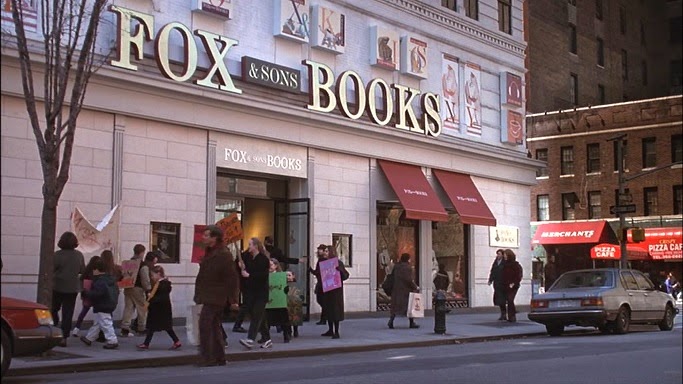
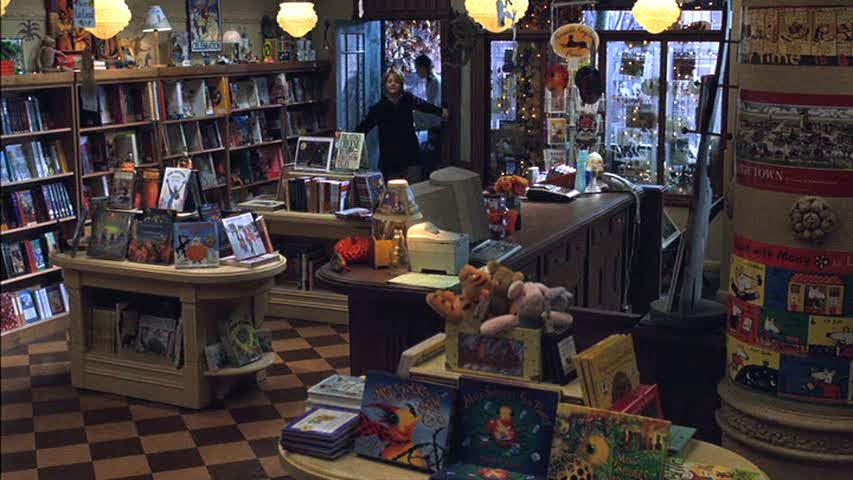
Fox & Sons Books—Revenge at Last

Hollywood, movies, film, blockbuster
Fictional Bookstore From You've Got Mail

We just returned from New York City. My son’s family lives on the Upper West side with his wife and three of my grandchildren. Our daughter, her husband, and our other three grandchildren joined us to make this a family get-together and special Thanksgiving celebration. We did it all … or at least some of us did it all. Others, like myself, sometimes hung back watching televised football.
I did join everyone on a jaunt to Times Square on Monday, but declined to return on Black Friday. 

times square
Toys R Us Times Square
On Monday, the weather was perfect, which meant that Toy R Us and other stores were sweltering without air conditioning. It didn't help that the shops were packed tighter than a sardine can. Jack Frost made a visit on Black Friday, so stale air and heat were less of an issue. The crush of the crowds, however, overwhelmed all other sensations. There are over eight million people in New York City. Half went to Macy’s and the other half traipsed down to Times Square … and they brought all of their relatives visiting for the holiday. All this is hearsay, of course. I stayed at my son’s apartment to watch Nebraska barely beat Iowa.

Ice Skating in Central Park

I also declined an ice skating excursion in Central Park. These days I’m not about to get on the ice, and stomping my feet on the sidelines to keep warm didn’t sound like much fun. My son texted live video of my grandkids skating, which gave me a rare appreciation for modern gadgetry.

I did do many other things, however. I watched my grandson score several touchdowns in the Yorksvilles Turkey Bowl on Randall’s Island, attended Mass at my granddaughter’s school, enjoyed my granddaughter’s performance in the Nutcracker Suite, celebrated my twin grandsons’ birthday, viewed balloons staged for the Macy’s Thanksgiving Parade, watched the parade from a precarious perch on a Central Park wall, consumed a traditional Thanksgiving dinner surrounded by family, and even found time to write.

independent bookstores
bookculture Bookstore in NYC
movies, film, hollywood
Shop Around the Corner from You've Got Mail
One of my favorite experiences was a new bookstore on Columbus and 82nd. The opening, rather than a closing, of an independent bookstore warranted a piece in the New York Times. The newness lured me in, but after my initial visit, I’m sure bookculture will be one of my regular haunts when I visit the city.

Borders is gone and Barnes & Noble closed several of their NYC stores. The Shop Around The Corner in the movie You’ve Got Mail was located close to the bookculture location. Perhaps the Fox & Sons Books model is growing thin. It’s ironic to see the behemoth boxes run out of business by Amazon, only to make room once again for intimate bookstores with a bookish atmosphere. In the end, I bet knowledgeable and friendly staff who understand local tastes will elbow themselves enough room to prosper.I hope so. 

When I visited bookculture, it was packed with people, many of them buying armloads of books. Granted, it was Black Friday, but sale pricing seemed limited. It was hard to tell if shoppers were buying for themselves or for Christmas. Whichever, I hope the store remains busy … and I hope books become the favorite gift for the coming holidays.

Suggested Gifts for Friends and Loved Ones


Sunday, November 16, 2014

Was Annie Oakley the Real Katniss Everdeen?


Doing research for Jenny's Revenge, A Steve Dancy Tale, I had reason to read up on Annie Oakley. It struck me that she had a strong resemblance to the fictional Katniss Everdeen of The Hunger Games.

Katniss is an exceptional marksman with bow and arrow who honed her skill by hunting to feed her fatherless family. In fact, she was so good at hunting, she traded her excess kills for other essentials needed by her family to survive. At 16 years old, Katniss becomes a celebrated hero due her unprecedented display of skill in a national show. To add spice to the story, she has romantic relationships with another contestant and her hunting partner.

At age 8, Annie Oakley started shooting game to feed her fatherless family. She sold her excess kills to a grocery store, and her hunting was so prolific that by 15 years of age, she paid off the family mortgage. Oakley became the first female superstar, famed all over the world for her shooting exhibitions in the Buffalo Bill Wild West Show. At age 16, she married a fellow contestant in a shooting contest, and her husband performed with Oakley throughout her career.

In 1875 on Thanksgiving Day, Frank E. Butler placed a $100 bet that he could beat any local sharp shooter. Annie Oakley beat Butler on the twenty-fifth shot. Some trick shootists might have resented losing to a five foot tall, fifteen year old girl, but Butler invited Oakley to join his act and they were married a year later. (There is some doubt about the actual year, but I’m going with the famous quote from The Man Who Shot Liberty Valance: “This is the West, sir. When the legend becomes fact, print the legend.”)

Oakley shot almost every gun known to nineteenth century man ... or woman. At ninety feet, she could hit a playing card set on edge, and then hit it repeatedly before it touched the ground. She hit dimes tossed in the air. She regularly shot the tip off a cigarette held between her husband’s lips. I’ve heard of never going to bed angry, but I bet this couple had a different motto.

I have never read that Suzanne Collins said Annie Oakley inspired Katniss, but as Mark Twain opined, truth is stranger than fiction.


western fiction
Coming soon: Jenny's Revenge


Tuesday, November 4, 2014

Jenny's Revenge at The Fictional Cafe

Western fiction

The Fictional CafĂ© has previewed the first chapter of Jenny’s Revenge, the fifth novel in the Steve Dancy series

If you enjoy fiction, bounce around the Fictional cafĂ©. You’ll find author interviews, sample writings, book reviews, and pod casts. Membership is free.


Western action adventure fiction
Honest Westerns ... filled with dishonest characters


Thursday, September 11, 2014

Word of Mouth Revisited

I’ve contended that word of mouth is the greatest marketing tool available to authors. Word of mouth includes book clubs, online recommendations at sites like Goodreads and LibraryThing, reader reviews, and good ol’ fashioned face-to-face conversation. Word of mouth does not include anything the author says, including social media leavings that come from gallivanting around cyberspace. Potent word of mouth comes unexpectedly from a trusted source. Every author’s marketing strategy must focus on generating positive word of mouth.

Recently, I had confirmation of this axiom. In the first of August, I ran a discount promotion for a couple of days for the e-book version of The Shopkeeper. I don’t believe in offering free e-books because there is no lasting effect beyond a couple days. Many people gather up free books and never bother to read them. I’ve discovered that there is an entirely different dynamic for 99¢ e-books. Evidently this tiny fee motivates people to read the book.

 I decided to use a brief 99¢ price for the first novel in the Steve Dancy Tales to give a boost to the entire series. It worked far better than I expected. Not only did The Shopkeeper sell almost two thousand copies, all the other books in the series showed accelerated sales. Actually, it has been over a month since the promotion and all five books in the series still sell at more than double the pace of sales prior to the promotion. Free e-books have no legs, but 99¢ e-books seem to have a long tail.

None of this was news to me. But I did make an observation about this promotion that had previously eluded me. If a promotion goes well and readers like the book, then word of mouth accelerates sales in other formats and for other books by the same author. I never track audio sales because they’re small compared to other formats. I kept an eye on them this time, and I noticed a major surge in sales about a week or so after the promotion. Print sales also surprisingly increased, and sales of my other books grew significantly. The additional sales could only come from word of mouth because none of these other books or formats were discounted or promoted beyond my normal feeble efforts. People who liked The Shopkeeper told other people about my books. Some marketing gurus tell you to make fans out of your readers. Good advice, but if you really want to sell lots of books, turn your readers into your own personal sales force.

How? Write an engaging story that never jerks your reader out of the story. This means you need to keep the story moving forward, avoid unnecessary plot detours, and have it all professionally packaged. If you enthrall your readers, they’ll tell their friends, family, and neighbors about this great new author they found. After you have a large and growing sales force, you can concentrate on what you really love to do—write.


Thursday, June 19, 2014

Reading: The Struggle … Really?

literary fiction

Reading a struggle? Tim Parks writes that modern man’s addiction to electronic gadgets means reading is relegated to odd snatches of time. His advice is that we dinosaur writers need to adapt and learn to tell a story in fewer words than were used in the theme song for The Beverly Hillbillies. (The 87 word tune at the beginning of The Beverly Hillbillies is famous for terse storytelling.)

Park opens his New York Review of Books article by writing, “The conditions in which we read today are not those of fifty or even thirty years ago, and the big question is how contemporary fiction will adapt to these changes, because in the end adapt it will. No art form exists independently of the conditions in which it is enjoyed.”


Adapt? Writing a story using Twitter might be fun and even creative as hell, but it would not be a novel. Park doesn’t actually suggest that writers restrict themselves to 140 characters, but he does predict that a novel “will tend to divide itself up into shorter and shorter sections, offering more frequent pauses where we can take time out.” To a great extent, this is because Park apparently believes fiction is art and must be studied, rather than merely enjoyed.

He writes:
“Let’s remember just what hard work it can be to read the literary novel pre-1980. Consider this sentence from Faulkner’s The Hamlet:
‘He would lie amid the waking instant of earth’s teeming minute life, the motionless fronds of water-heavy grasses stooping into the mist before his face in black, fixed curves, along each parabola of which the marching drops held in minute magnification the dawn’s rosy miniatures, smelling and even tasting the rich, slow, warm barn-reek milk-reek, the flowing immemorial female, hearing the slow planting and the plopping suck of each deliberate cloven mud-spreading hoof, invisible still in the mist loud with its hymeneal choristers.’”
Could he have found a more writerly example? Mark Twain would never write a sentence like that. For that matter, neither would JK Rowling, Stieg Larsson, or Raymond Chandler. Good grief. Maybe it was pompous writing, not texting that drove people away from long format fiction.

Except that people have not abandoned novels. Novels are increasingly popular. Instead of the novel adapting to modern lifestyles, our lives have adapted to reading in a different manner. Many of us do our reading on e-readers that we bring with us all the time because they weigh less than a Little Golden Book.  

A good novel is the best stress reliever ever invented. A good novel captivates the reader. A good novel instantly transports the reader to another place and time. And a good novel is inexpensive and accessible

A novel provides a unique escape from the relentless pinging for our attention. Despite what our ego may tell us, being constantly tethered to an iThingy is not obligatory. The world will not miss you for an hour or so. When you need a break, just turn off your other devices and open a novel. Give a storyteller some dedicated time and you’ll be able to handle your concerns and responsibilities with aplomb.

Monday, June 2, 2014

Amazon Changing its Customer Rating System?

This seems like a good time to discuss Amazon’s ratings because The Shut Mouth Society has reached 100 Amazon customer reviews. Amazon appears to be in the middle of changing its rating system. (Ratings are the number of stars that customers give a product.) Or at least I presume it is in the middle of a change because the calculation for print/audio and Kindle ratings is different. At the top of the page for print/audio editions, there are now two numbers associated with the star ratings. The first number is the number of ratings without reviews and the second number is the count of reviews. The new rating appears to be a weighted average of these two numbers.

For example, The Shut Mouth Society has 100 reviews for 4.3 stars. The print/audio editions also display 162 ratings without reviews. There is a nifty roll-over chart which shows a combined 4.1 stars with a bar graft and sample review comments. (A roll-over chart is displayed automatically when you roll the cursor over the review count.)

suspense thriller
100 Reviews for 4.3 Stars

Some authors seem upset with the new system because their ratings declined. Mine did as well, but I favor the new system. I believe a larger sample size adds credibility to the quality assessment. I suspect those most upset were gaming the old system and their bogus reviews were diluted under the new system.

Amazon rankings and ratings

My remaining question is what is the source of these additional ratings. Amazon acquired GoodReads over a year ago, but the numbers don’t correspond to their ratings. I suspect these new ratings come from Kindle readers, who can assigned a star rating upon completion of a book.

Whatever the case, as far as I’m concerned, the more, the merrier.

Update, 06/04/14:

Ratings seemed to have reverted back to their old selves, so ... never mind.

Friday, May 16, 2014

Book Titles that Grab Attention

Coming up with a good book title is difficult, at least for me. Ideally, you want the title that will grab a buyer’s attention in three or so words. The title is actually only half of a selling partnership. The cover and title work together to entice a purchase. People do judge a book by its cover and the cover entails an image with a few words. If either appears incongruent, buyers move on to the next offering.

Constitutional convention historical novelMy favorite is Tempest at Dawn. Since the book is a dramatization of the Constitutional Convention, I wanted the title to sound like a novel, not a nonfiction history book. The cover design put the title in context: a stormy sky over the Pennsylvania State House flying a thirteen star flag. For me, the title evokes a troubled nation at its founding, but some, who otherwise raved about the book, criticized the title as unrelated to the story. I still like it.

In my Western series, I wanted the sub-title prominent to remind readers there were more Steve Dancy Tales, so I chose simple titles that include: The Shopkeeper, Leadville, Murder at Thumb Butte, The Return, and Jenny's RevengeI’m currently working on Crossing the Animas


The covers are black and white because I wanted a design that indicated that these were a different type of Western: different from books with loud and colorful cover illustrations showing action or looming violence. The series has been very successful, so hopefully this is partly due to the covers and titles because I intend to continue the pattern for the remaining books in the series.


My approach will not work for everyone, but viewing the cover design and title together as a selling unit will garner sales. For a confirming case study, read about my blunder with The Shut Mouth Society.

By the way, The Meta Picture has a fun article titled “These Books Actually Exist,” which lists 20 outrageous titles and covers. Wonder how some of these sold.