Showing posts with label #libraries. Show all posts

Friday, October 16, 2015

Jenny’s Revenge Available in Print

At long last, Jenny’s Revenge, A Steve Dancy Tale is available in trade paperback format. This has been a long process that had mostly to do with abnormal issues around the cover design. The book can be ordered from Barnes and Noble, Amazon, Books a Million, or independent book stores. Thank you for reading The Steve Dancy Tales.

literary fiction book series
Honest westerns filled with dishonest characters

Jenny Bolton has plans, and they don't bode well for Steve Dancy.
Married at fifteen to a Nevada politician, Jenny suffered repeated assaults, witnessed her husband's ghastly murder, buried her vile mother-in-law, and killed a man. Dancy, who had once served as her paladin, rejected her without as much as a goodbye. Abandoned on a raw frontier, she's single-handedly building an empire that spans the state. Despite her triumphs, she feels she never should have been left alone.
Soon to marry, Steve is eager to begin a new life unaware that Jenny is mad for revenge.

Monday, October 13, 2014

Damn Research Anyway


I write historical novels. Most of my books are Westerns, and I strive to properly reflect the lifestyle, technology, and politics of the era. Tempest at Dawn, my big historic novel, is a dramatization of the Constitutional Convention. Even The Shut Mouth Society, my contemporary chase-thriller has strong historical content centered on Abraham Lincoln.


faceoff
Joseph Finder

When I’m busy and I discover an interesting web article, I bookmark it to read later. This morning, I read Joseph Finder’s article Research: A Writers Best Friend and a Writer’s Worst Enemy.

I think Finder has it just about right. He alludes to my worst habit: using research to procrastinate, but couches it far too narrowly. When I’m on a roll, I never let research get in the way of getting the story down in black and white. On the other hand, when I don’t really want to write, I bounce around the web and tell myself I’m making progress through research. Somehow, I convince myself of this even when I’m watching the GoPro video of the week.


A few years ago, I wrote an article on the hazards of web-based research. I even put together a Powerpoint presentation for a writer’s group. Today, I use the web more frequently for research. One reason is the proliferation of primary source documents. The second reason is that reputable institutions have digitized their content. The web has grown up. Except for odds and ends, I rarely use Wikipedia. There are many more authoritative sources if you know how to find them.


Research can also be in the real  world. For instance, I need to walk the ground of my novels. I’m not a visual person, so I take gigabytes of pictures to look at as a write descriptive prose. Walking the ground has another purpose. Every locale has a distinct feel to it. When I deplane in Phoenix or Honolulu, I know where I’m at as soon as I feel and smell the air. Some writers are geniuses when it comes to descriptive prose, but to describe ambiance, I need to experience it. Besides, this is the fun part of research. Wandering around Virginia City or Old Denver sure beats trying to verify the exact time Virgil Earp lived in Prescott, Arizona.


Friday, July 25, 2014

Publishing advice for a relative


A relative asked for advice on how to publish a math book he had written. I've included my answers below in the hope it might help other aspiring writers.


I would strongly suggest traditional publishing for a math book. You are correct that traditional publisher have access to the proper sales channels. In fact, academia seldom buys self-published books, so traditional publishing is your best, and possibly only, option.

James D. Best publishing advice
Many people say you must have an agent to traditionally publish. This is true for fiction and popular nonfiction, but not always required for specialized nonfiction. Some publishers accept non-agented manuscripts. My suggestion is to seek an agent and a publisher simultaneously. To find out how to do this, spend a few hours in a library with Jeff Herman's Guide to Book Publishers, Editors and Literary Agents. Read the articles about how to write query letters, book proposals, select an agent/publisher, etc.


Here are a couple of publishing clichés that became clichés because they are often true:
Fiction is published based on the author’s platform, and published nonfiction is based on the author's credentials. 
Nonfiction is sold with a book proposal; novels are sold as a complete manuscript.
This means you should stress your math credentials in your query letter and book proposal. Book proposal formats vary, but they all include a sample chapter, Table of Contents, a section on the author, and a section on the target market.

Don’t worry about a publisher stealing your concepts. Also, if the agent you query is listed in Herman’s book, you don’t need to be concerned about him or her stealing your ideas either. You will need to use your judgment with friends and colleagues.

All of this means you should not wait until your book is complete to your satisfaction. Hone one chapter until it is as good as you can make it and include the other sections required in a book proposal. Then send query letters out to publishers and agents simultaneously. Don’t send a proposal or manuscript unless you get a positive response from a query because it will just end up in a slush pile destined to be read by an intern … someday … perhaps. If you use this approach, you will have plenty of time to complete the entire book to your satisfaction. In fact, publishers assume nonfiction books are not complete at the time of contract signing. A standard clause is a book delivery schedule.

Which brings us to terms and conditions. The sad truth is that unless you are famous or have committed a high-profile felony, you have little influence over the T&Cs, which include royalties. This is true if you negotiate the contract yourself or have an agent negotiate it on your behalf. These contracts are boilerplate for the most part. The agent’s job is to secure the biggest advance possible. My agent also negotiated out a first-rights clause for a second book, but he was able to get little else. Ancillary rights are demanded by traditional publishers. Wiley even insisted on the theatrical rights to my computer management book. (I was thinking of a musical.)

The primary benefit of an agent is to get your manuscript moved to the top of the pile. Agents also know the interests of different publishers and can keep you out of cul-de-sacs. If you query publishers directly, use Herman’s book to select publishers that specialize in your subject or market. 

Nowadays, traditional publishers are paying higher royalties on e-books, but nowhere near the direct payments to independent authors. Traditional publishers pay an advance, so they are concerned first with earning back the advance. Indie-authors higher royalties reflect the fact that they receive no advance and pay publication costs.

Traditional publishers will take care of “cleaning up a book.” Wiley assigned an editor and 3 line editors to my book. They also insisted on control over the title and cover. It’s been many years since I published The Digital Organization, and things may have changed, but basically the publisher calls most of the shots.

As for my books, if you are interested in history, I recommend Tempest at Dawn. If you like action/thrillers, then I would recommend The Shopkeeper or The Shut Mouth Society.


historical fictionAction thriller suspense


Sunday, April 13, 2014

New York Public Library—Struggling to Stay Relevant

Last post I commented on how the New York Public Library has become a gathering place for electronic enthusiasts who never feel a need to bother a librarian. Most of the patrons I observed were focused intently on computerized devices. An indication of the library’s struggle for relevancy can be found on their website. The above the fold promos are for The Beatles and Tax Day, April 15, neither of which is what one would normally associate with arguably the country’s second most important center of literature and research material. (I put the Library of Congress in first place.)


Other front-page teasers include:
“Make ‘Em laugh: Gut busting Picture Books—NYPL's Elizabeth Bird shares some picture books that will have both adults AND kids rolling in the aisles.”
“Game of Thrones is Back! Now Where is it Going?— NYPL's Shawn Donohue ponders how George R.R. Martin's hit book series will manifest on screen this season.”
“Mad Men: The Beginning of the End— NYPL's resident Mad Men blogger Billy Parrott speculates on what's to come in the seventh season of the hit show.”
“Craft BeerStevie Feliciano of the Hudson Park Library shares her adventures in beer tasting and home brewing, along with some helpful books for novices.”
The Home page includes a few traditional library themes, but they are overwhelmed by appeals to pop culture. I suppose the idea is to get New Yorkers into the library in the hope they’ll learn something they couldn’t pick up from People magazine.

The most disappointing part of the NYPL webpage was found at the very bottom: “The ABC of It: Why Children's Books Matter.” This is an enlightening exhibit of children’s books that promotes reading, art, and appreciation of literature.  This exhibit is exactly the type of event libraries can use to attract new patrons. It’s colorful, nicely organized, learning centric, and above all, interesting.  “The ABC of It” deserves to remain above the fold for as long as it's open.

Friday, April 11, 2014

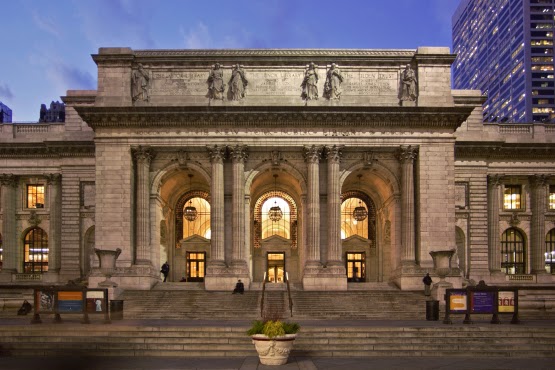
New York Public Library—A Museum or a Hive of Erudition


The New York Public Library is one of the world’s great institutions. The Map Room is grand space with an impressive collection. The Reading Room is outsized and majestic. The comprehensive Art & Architecture Collection is housed in yet another gracious room.

I have written previously that libraries may eventually become museums for printed books.Are books becoming obsolete? Is a library the only place we’ll be able to see these odd antiquities? Will librarians admonish us to “don’t touch,” instead of shushing chatterboxes? Are we entering a binary world where everything is decomposed into a series of ones and zeros and then instantly reassembled on a hand-held device?”


Nothing epitomizes this eventuality more than the New York Public Library. There seem to be miles of marble hallways that can accommodate twelve abreast, super-high ceilings, broad staircases galore, and very few books. The stacks are forbidden to all except the high priesthood and nowhere in sight. In fact, it’s rare to see a printed book even in the Reading Room. Everybody seems engrossed in computer or iPad screens umbilicaled to handy electrical outlets that run down the center of the tables. Only two rows of tables in the far back restrict computers and e-readers. On the day we were there, these were the only available seats in the expansive room.

I don’t lament the rarity of printed books, but I fear we might lose the expertise of librarians. I saw few people get up from their prized seats to make an inquiry to one of the staff. I suspect if they wanted an answer, they Googled it at their table. What a shame. My experience with librarians is that they are not only highly knowledgeable, but eager to share their knowledge. Unique nuggets of information cannot be discovered on Google, but a librarian can point you toward a source that can elicit a eureka moment. Print is a medium and a book can be presented in other formats without losing all of its worth. On the other hand, the demise of librarians would be a tragedy.