Showing posts with label dialogue. Show all posts

Thursday, July 18, 2019

Deadwood: The Movie

Even the film poster celebrates the F-word

(Spoiler alert: if you're a Deadwood fan, you won’t like what follows.)

I watched Deadwood: The Movie last evening. A little late to the game, but it's difficult to watch this western with teenage girls in the house. Actually, the three thirteen-year-olds have only lived with us a week and the HBO Film has been available for over six weeks. In truth, I wasn’t keen to see it. After three separate attempts, I never finished the series … and I write Westerns for a living. What’s wrong with me?

I loved the television show until Wild Bill Hickok died, then I no longer cared about any of the characters. Deadwood didn’t draw me back because the story wasn’t compelling. Same for the HBO Film. The movie tied up every loose end, and every actor got to invoke their character’s iconic pose, but the main storyline could easily have been captured within a single episode. The rest felt like fill and forced nostalgia.

The problem with Deadwood is the overuse of visual and dialogue gimmicks to project an artful image. The ploys get old after a few episodes. The harsh profanity mixed with stylized formal speech reminded me of Betty White using the F-word; funny at first, tiresome with repetition. The cardinal rule of storytelling is to never take the reader/viewer out of the story, and the odd dialogue did just that.

Many believe the stilted speech—punctuated with swearwords—made the show unique and artsy. Executive Producer David Milch insists that the vulgar, Elizabethan-like dialogue is based on historical research. To steal a word from the era: poppycock. No characters talked this way in any of the stories by Mark Twain, Louisa May Alcott, or Owen Wister, who were all there. In that age of propriety, they would have omitted profanity, but I doubt Wild West speech would make rap singers sound virginal. In case you think I'm a prude, I occasionally use harsh profanity in my novels, but sparingly, so the impact is not diluted by repetition.

The Deadwood dialogue reminds me of James Fenimore Cooper’s attempt to invoke an earlier age with excessively formal language. Cooper wrote historical novels that occurred about a hundred years in the past. Mark Twain, my favorite Western author, didn’t like Cooper’s writing. Wait, that was far too mild of a sentence. In his article “Fenimore Cooper's Literary Offenses,” Twain ridicules, lacerates, and skewers Cooper.

I may be mistaken, but it does seem to me that "Deerslayer" is not a work of art in any sense; it does seem to me that it is destitute of every detail that goes to the making of a work of art; in truth, it seems to me that "Deerslayer" is just simply a literary delirium tremens. A work of art? It has no invention; it has no order, system, sequence, or result; it has no lifelikeness, no thrill, no stir, no seeming of reality; its characters are confusedly drawn, and by their acts and words they prove that they are not the sort of people the author claims that they are; its humor is pathetic; its pathos is funny; its conversations are -- oh! Indescribable;  its love-scenes odious; its English a crime against the language.
Counting these out, what is left is Art. I think we must all admit that.

Twain wrote about dialogue in another section:

When the personages of a tale deal in conversation, the talk shall sound like human talk, and be talk such as human beings would be likely to talk in the given circumstances, and have a discoverable meaning, also a discoverable purpose, and a show of relevancy, and remain in the neighborhood of the subject at hand, and be interesting to the reader, and help out the tale, and stop when the people cannot think of anything more to say. But this requirement has been ignored from the beginning of the "Deerslayer" tale to the end of it.

Even the style of this article is meant to mock formalistic writing.

In summary, the starchy speech demanded attention but didn’t enhance the storytelling. I found the volume and volume of profanity off-putting and wearisome. The nostalgic scenes didn’t work for me because I hadn’t missed the characters. Excluding that, what is left is pretty good. I think we all must admit that.

You might also like: Mark Twain Tells Us How to Write

Wednesday, March 19, 2014

Talk is not cheap!

“People don't talk like this, theytalklikethis. Syllables, words, sentences run together like a watercolor left in the rain. “ Bill Bryson, The Mother Tongue: English and How It Got That Way
“If writers wrote as carelessly as some people talk, then adhasdh asdglaseuyt[bn[ pasdlgkhasdfasdf.” Lemony Snicket, Horseradish

When I was at the Tucson Festival of Books, I was asked how I learned to write dialogue. Although I had no intention of ever writing a movie script, I studied several books on screenwriting. Screenplays focus on dialogue with only sketchy descriptions of place. The spoken word is crucial for all movies that don’t spray spent casings all over the landscape or use explosive fireballs to punctuate scenes. So, if you want to improve your dialogue skills, study screenplays.

Dialogue exists in novels to move the plot forward or to reveal character, or both. There is no place for small talk in a novel. Every word that’s inside quotes—or outside, for that matter—must have a purpose. Dialogue is engineered by the author. It is not natural, but must sound natural. Authenticity comes from providing clues so the reader can fill in the blanks. For example, a hint of an accent is all that is needed for readers to hear a character speak a dialect.

Richard Ford wrote in The Lay of the Land, “You rarely miss anything by cutting most people off after two sentences.” This is perfect advice for your characters. Dialogue should be taut and tense. Off the top of my head, here are a few other thoughts on dialogue:
  • Dialogue is not the place for exposition.
  • Soliloquies are out of style.
  • Characters should not tell each other what they both already know.
  • Heavy accents and odd speech patterns take the reader out of the storya mortal sin.
  • Different characters should speak differently.
  • Personality is revealed in how your characters speak and what they say.

These are not rules, but guidelines. Each one will be broken brilliantly by writers who know exactly what they are doing. I can’t wait to read their work.

Monday, July 1, 2013

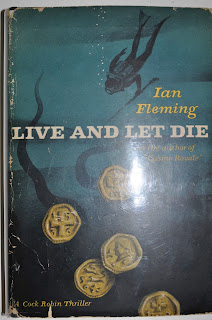
Full of Surprises—Live and Let Die by Ian Fleming

Ian Fleming

In high school, I read every Ian Fleming James Bond book. I liked them, but wasn't motivated to read them a second time until recently. I started with Live and Let Die, the second book in the series. The novel was full of surprises. I remembered that Bond was a different character than in the movies and the plots were less extravagant.  All true. James Bond is vulnerable and feels fear in the books. He is not as much of a loner and makes friends easily. The plot doesn't make sense in either the book or movie, but the action/escape scenes tend to the more realistic side in the novel. There is a fetish about equipment, but in the book, Bond is given somewhat specialized scuba gear, while in the movie, Roger Moore wears an electro-magnetic watch that can pull a wooden row boat by it metal rowlock. Fleming does not give Bond futuristic gadgetry. A steel-toe shoe is about as exotic as it gets.

Original book cover
First Edition Cover
Fleming was a much better writer than I remembered. His pacing was pitch-perfect and descriptions excellent. Although the dialogue often seemed pedestrian, Fleming was a great storyteller. Live and Let Die was an easy read, and there were more than a few times when I reread a section that showed skillful writing.


The big surprise was the racism reflected in this 1954 book. Fleming occasionally writes favorably about his black characters, but for the most part he relies on offensive words and stereotypes that were more generally accepted than we would like to remember. Fleming’s attempt to reflect black ghetto dialects seems crude and wrong. This novel demonstrates that racial attitudes have improved in the last sixty years. Perhaps everyone, especially the young, should read Live and Let Die to gain a fuller understanding of the 1950s.

Friday, June 28, 2013

Jane Austen's Unpublished Work

bestselling famous authors
I’m a Jane Austen fan. That probably seems odd since I’m male and write Westerns. The Wild West and English countryside have little in common. But I’m talking about writing, not venue. I admire great dialogue and consider Jane Austen the champion. (My books tend to be dialogue driven, but I don’t consider myself in the same league with Ms. Austen.) 

Although good description is essential, I seldom find myself stopping to admire a piece of prose describing the landscape. But perfect dialogue stops me every time. My fascination with dialogue probably comes from my own inept retorts. I always think of the right thing to say hours later. Writing novels, I can return to a scene and insert a whiz-bang snippet of dialogue any time I want. Fiction is great.

The mantra of writing is show, don’t tell. Dialogue is an effective way to show character. Here is an example from Pride and Prejudice. This is the reader’s first introduction to Mr. Bennet.


Mrs. Bennet says,
"Mr. Bennet, how can you abuse your own children in such a way? You take delight in vexing me. You have no compassion for my nerves' "

"You mistake me, my dear. I have a high respect for your nerves. They are my old friends. I have heard you mention them with consideration these twenty years at least."

In fifty-eight words, Austen has gone a long way in showing us the character of two major figures in her story. 

I bring Austen up because I found a website with her unpublished work in both manuscript and transcribed formats--side by side. Most of this is not her best work, but writers and Austen enthusiasts may find it interesting. You can find it here.

Related Posts:

Wednesday, January 23, 2013

A Dramatic Reading of Tempest at Dawn


SAGE in Northridge, CA is doing a dramatic reading of Tempest at Dawn. The SAGE Society is a learning-in-retirement organization sponsored by California State University, Northridge. The group has adapted the novel to a play-like script and members assume the roles of various framers of the Constitution. The readings will extend over many weeks, but yesterday I had the privilege of attending the first reading of chapters 1-4. The society members did a wonderful job and it was a kick to hear other people read my words aloud. This was a fun group and the performance and banter showed that the members were learned, full of life, and welcoming to new members and experiences. After Tempest at Dawn, they will do a reenactment of the Virginia Ratification Convention, which they will script from other sources. I felt honored that SAGE has dedicated their time and meetings to Tempest at Dawn.


Monday, January 21, 2013

Louis L'Amour, The Read Deal


If your name was Louis L'Amour and you wrote about men tougher than nails, would you adopt a penname? Frederick Faust used Max Brand to publish his rough and tumble Westerns. Of course, that was partly because Faust was a Teutonic name, and the Great War had made Germans unpopular.

Saul David, editorial director of Bantam Books, told Donald Jackson a story he included in a Smithsonian Magazine article. "That was the heyday of the paperback Western. We had lost Luke Short, our Western Star, and I was in California looking for a new one. I got a call - the word was out that I was in town - and a voice said, 'This is Louis L'Amour, you've never heard of me but I want to see you right now.' He came up with an envelope, made a pitch and told me to read his samples. He said he was going to be the next great Western writer and we'd do well to take him on. I read it while he waited. It was Hondo, and it knocked me out. I signed him to a long-term contract on the spot … David's boss in New York had doubts about their new author's name - L'Amour on a paperback sounded like ‘a Western written in lipstick,’ he said - but no one had grit enough to ask him to change it, ‘I didn't want to get punched out,’ David explains.”

At the time David met L’Amour (1908-1988), he was nearly fifty. He had mellowed a bit in middle age, but could still throw a hefty punch. For almost his entire life he would spend over an hour each day lifting weights, skipping rope, and punching a bag.

It might seem that L’Amour started late in the writing field, but that would be incorrect for two reason. First, he wrote for the pulps before WWII. (He took an extended hiatus during his enlistment.)  After the war, he sold at least one story per week prior to the film Hondo. There is a legend that John Wayne made L’Amour’s career when he bought the theatrical rights to a short story that became Hondo. Wayne also endorsed of the later novel as the best Western he had ever read. The Duke certainly gave L’Amour a big boost, but L’Amour was making a decent living from writing prior to Hondo. He had already sold several novels to paperback publishers and had sold several other projects for movies and TV.

The second reason would be research. He spent his early years living the life he would later write about. During his upbringing in North Dakota, his father’s veterinary practice and his other relatives exposed him to ranching and genuine cowboys. As a youth, L’Amour traveled the world as an itinerate worker. He hoboed, skinned cattle, baled hay, worked in mines, saw mills and lumber yards, circled the globe as a merchant seaman, and boxed all over the globe for money. He went out of his way to meet lawmen and outlaws. He traveled everywhere, noticed everything, and read constantly. He bragged that from 1928 until 1942 he read three books a week. By the time he met David, his life experiences and pulp writing had thoroughly prepared him to be a novelist.

Louis L'Amour wrote over one hundred books, of which more than 30 have been made into movies. He was extremely prolific and once signed a thirty book contract with Bantam. His books have been translated into over fifteen languages. A few days before he passed away, L’Amour was notified that sales of his books had topped two million. Today, that number is well in excess of three million. None of his titles have ever been out of print.

He loved writing and storytelling. He said, "I can transport myself to another time and place and put myself there." 

Critics panned his dialogue and one-dimensional characters, but praised his pacing and historical accuracy. L'Amour dismissed their criticism. "If you write about a bygone period east of the Mississippi River, it's a historical novel. If it's west of the Mississippi it's a Western." He added, "I don't give a damn what anyone else thinks, I know it's literature and I know it will be read 100 years from now." 

Twenty-five years after his death, his prediction looks accurate.

Friday, December 14, 2012

Leonard's ten rules for writing


Owen Wister
Elmore Leonard


In 2009, The Western Writers of America presented Elmore Leonard with their prestigious Owen Wister Award for lifetime achievement. Leonard wrote 3:10 to Yuma, Hombre, Last Stand at Saber River, and many other Westerns. He also wrote novels outside the Western genre, including Get Shorty, Jackie Brown, and Out of Sight.

Leonard published his 10 Rules of Writing, which was actually a padded version of his New York Times article. The book may be panned for its brevity, but the advice is sound.

Leonard's ten rules for writing

1. Never open a book with weather.
2. Avoid prologues.
3. Never use a verb other than "said" to carry dialogue.
4. Never use an adverb to modify the verb "said."
5. Keep your exclamation points under control.
6. Never use the words "suddenly" or "all hell broke out."
7. Use regional dialects, patois, sparingly.
8. Avoid detailed descriptions of characters.
9. Don't go into great detail describing places and things.

Tuesday, October 23, 2012

Did pirates say “Arrrr, Matey?”


Robert Newton
Writing good dialog is hard. It’s especially hard for historical fiction. How did people talk in some long ago period? A writer can get a hint from historical writing, but only a hint. Peopleat least prior to email and textingwrote in a much more formal style than they spoke. As recently as twenty years ago, people wrote striving for grammatical correctness and they generally shunned slang they might use verbally.

Another challenge is to make every character sound different. Beyond personality differences; women, men, and children don’t talk the same. If every character speaks similarly, dialogue becomes akin to a vegan gluten-free green smoothieboring in large doses.

The best way to give each character a distinct voice is to have a firm grasp of the character’s personality. Really know your characters. Allow them to speak for themselves … and if they happen to say something out of character, erase it.

The top goal of fiction writing is to move the story forward. This means dialogue should not interrupt the forward progress of a story. This argues for not going overboard on regional or historical accents. A reader should never stop to sound out some unusual speech pattern in order to figure out what the character said. For the most part, it’s better to offer hints of a bygone era rather than attempt to replicate it accurately. A light touch is almost always best. One of the great historical novels is Pillars of the Earth by Ken Follett. Read the book again for the language. You might be surprised. For the most part, it is written in modern English.

Oh, one more thing. In the early 1950s, Disney produced Treasure Island and Blackbeard the Pirate, with Robert Newton playing the lead role in both films. Newton also played Long John Silver in the TV series. In his portrayals, Robert Newton invented what became an iconic pirate dialect, including, “Arrrr, matey.” Was it accurate? Who knows, but it was entertaining … and understandable.

Tuesday, October 2, 2012

Buzz Feed' s Collection of 30 Writing Tips

This is a fun posting on Buzz Feed. Some very good advice, as well. 

Before you become too enamored with other authors' perspective on the craft, I'd like to add this piece of advice from Raymond Chandler: "Everything a writer learns about the art or craft of fiction takes just a little away from his need or desire to write at all. In the end he knows all the tricks and has nothing to say."

Link to Article

Thursday, February 23, 2012

Stonewall Grant reviews The Shopkeeper

"The Shopkeeper did not disappoint. It's well written with deep characters (that we care about) and a swift plot that keeps the pages turning.  The descriptions of the vast Nevada country are ample without the overkill. Great dialogue and a well contrived plot."

Wednesday, January 4, 2012

Murder at Thumb Butte reviewed at Bookviews


Alan Caruba at Bookviews writes: 


"When it comes to westerns, novels that evoke a fabled period, few do it better than Jim Best. His latest is Murder at Thumb Butte ($12.95, Wheatmark, Tucson, AZ, softcover) and I guarantee that you will also want to read The Shopkeeper and Leadville. These are part of a “Steve Dancy” series and, in the case of Murder at Thumb Butte, it is the spring of 1880 and Dancy has traveled to Prescott, Arizona to gain control of a remarkable invention. He has barely unpacked when he learns that his friend, Jeff Sharp, has been arrested for a midnight murder and Dancy launches an investigation to find who really did it. The problem is, the whole town of Prescott wanted him dead! He turns to another old friend, Captain Joseph McAllen of the Pinkerton National Detective Agency to sort out the suspects and find the real killer before Sharp ends up swinging from the gallows. Best is best at dialogue and his novels move along at a swift pace with some of the best dialogue you’ll find. Nothing fancy, but it reflects real people in real situations. Treat yourself to one or all three of the series."

Saturday, February 14, 2009

The secret to great dialogue

Art, literature,
Dialogue by Doc Ross, Christchurch, New Zealand
Dialogue in fiction is not conversation. At least not the kind of conversation we have every day. Fictional dialogue always has a purpose. It must move the plot and be character revealing.

Many writers have difficulty with dialogue. Is there a secret? Yes: know your characters. You should know your characters as well as your best friend. Some writers create elaborate back stories, even if they never intend to use them. Others prefer to outline personality traits. I like to take long walks and have conversations with my characters. To get to know your characters, use whatever method feels right for you. Once you understand them, you'll soon discover that your characters speak with a consistent outlook and come across as real people. When you know your characters, all you do is put them into the right situation, give them something to accomplish, and then transcribe their conversation.

The following example is from my book, Leadville. The plot required me to move my characters to another location. This may not be a great literary example, but it illustrates how to make a mundane transition more interesting by letting the characters speak naturally.


Sharp and I stood outside the livery corral kicking our spurs into the dirt.
“Let’s get a ham steak,” Sharp said.
“Bit early for a noon meal.”
“Hell, McAllen went to see his ex-wife. No tellin’ how long he’ll be, and we might not see a hog for months.”
“You said something similar this morning when we ordered that glutinous breakfast.”
“True this morning, true now. If ya hadn’t hired them boys, you’d be hungry too.”
“What if McAllen shows up?”
Sharp leaned around the corner of the barn and yelled at the liveryman. “If a gruff gent comes lookin’ for us, tell ’im we’re at the café.” Sharp turned and gave me a pleased look.
“What if he comes before we finish our meal? You know McAllen.”
“Then we git up and head for the hills.”
“Could be a waste of money.”
“Might be right.” Sharp pushed himself away from the barn wall. “So you pay.”
And off he went.

Western fiction action adventure
Honest Westerns ... filled with dishonest characters