Showing posts with label character development. Show all posts

Wednesday, September 11, 2013

Book Reviews—The good, the bad, and ...

western fiction

There are no ugly book reviews only good and bad reviews.  At least that would be true under the axiom that any publicity is good publicity. The Return, A Steve Dancy Tale recently received one of each. Let’s start with the good.

Bookviews by Alan Caruba is one of my favorite book blogs. Caruba is a writer by profession and a longtime book reviewer. In his review of The Return, he puts me in the same paragraph with Elmore Leonard. That alone puts Bookviews into my favorite column, even if Caruba hadn’t already reviewed most of my other books. He writes: “James D. Best … is arguably one of the best writers of westerns.” Those are kind words, and I appreciate them. You’ll find Caruba’s review of The Return in his September Picks of the Month.


On the other hand, at Brandywine Books, Lars Walker writes, “The Return, another Dancy story, is another well-written tale,” but adds, “it turned me off the series, not because of the writing, but because of one of the themes.” It seems Mr. Walker was offended by Dancy's interaction with his snobbish mother. He writes, “Steve’s ability to defy her through premarital cohabitation is presented as a sort of moral triumph.” A good observation, but I feel obligated to support my characters despite their failings. You can read Walker’s review of The Return by clicking on this link.

The Return, A Steve Dancy Tale has also received some nice reviews by Amazon Readers.
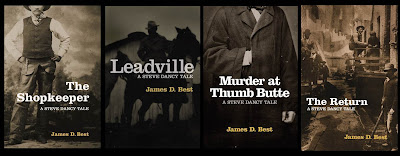
Western fiction
Steve Dancy Tales

Friday, June 28, 2013

Jane Austen's Unpublished Work

bestselling famous authors
I’m a Jane Austen fan. That probably seems odd since I’m male and write Westerns. The Wild West and English countryside have little in common. But I’m talking about writing, not venue. I admire great dialogue and consider Jane Austen the champion. (My books tend to be dialogue driven, but I don’t consider myself in the same league with Ms. Austen.) 

Although good description is essential, I seldom find myself stopping to admire a piece of prose describing the landscape. But perfect dialogue stops me every time. My fascination with dialogue probably comes from my own inept retorts. I always think of the right thing to say hours later. Writing novels, I can return to a scene and insert a whiz-bang snippet of dialogue any time I want. Fiction is great.

The mantra of writing is show, don’t tell. Dialogue is an effective way to show character. Here is an example from Pride and Prejudice. This is the reader’s first introduction to Mr. Bennet.


Mrs. Bennet says,
"Mr. Bennet, how can you abuse your own children in such a way? You take delight in vexing me. You have no compassion for my nerves' "

"You mistake me, my dear. I have a high respect for your nerves. They are my old friends. I have heard you mention them with consideration these twenty years at least."

In fifty-eight words, Austen has gone a long way in showing us the character of two major figures in her story. 

I bring Austen up because I found a website with her unpublished work in both manuscript and transcribed formats--side by side. Most of this is not her best work, but writers and Austen enthusiasts may find it interesting. You can find it here.

Related Posts:

Friday, June 14, 2013

Should a Writer Use Friends as Characters?


No!

Well, that's the simple answer. I have a rationale behind my answer:

  1. If the friend doesn't like the characterbye, bye friend
  2. Once started, there's no end
  3. I write the story for readers, not to amuse people I know
  4. My characters have a mind of their own ... and it's never the same as someone I know


I have used friend names for characters, but those characters were very different people. So different that there would be no confusion. I do this occasionally as a tiny nod of acknowledgment. Besides, some of my friends have cool names.

mystery fiction
Be nice to this woman
That said, I have been tempted to follow Mary Higgins Clark's example.

“When someone is mean to me," she said, "I just make them a victim in my next book.”

Now that's a great idea. 

I've encountered a few people I’d like Steve Dancy to castigate. (That’s castigate, not castrate.) I’ve restrained myself so far because of rule #2. I think that if I ever succumbed to temptation, I'd definitely be stepping onto the proverbial slippery slope.


Wednesday, March 20, 2013

Author Interview with Robert Peecher


Robert Peecher, author and journalist, has published an interview with me on his blog.


Q. When you started writing did you know Steve Dancy’s character, or did he develop for you through the telling of the story?

Best: I knew his character from the start, but that said, every character must grow or the story will become stale. By the fourth book, he is a much more mature character than at the beginning of the series. I had nothing to do with it. He learned and grew as he ventured around the frontier and I scribbled down what he did and how he did it.
The Steve Dancy Tales

You can read the full interview at robertpeecher. 

Saturday, January 19, 2013

Cowboy up!

I recently ran across Cowboy Values by James P. Owen. The book looked intriguing, but when I went to buy it, I decided to start with Cowboy Ethics, Owen's first cowboy book.

Cowboy Ethics is like getting two books in one. The first is a kaleidoscopic tour of cowboy life. Owen’s description of cowboy ethics is the purported purpose of the book, but renowned Western photographer David R. Stoecklein’s pictures grab the reader’s attention. Breathtaking photographs appear on nearly every page and alone are worth the price of the book.

The full title is Cowboy Ethics, What Wall Street Can Learn from the Code of the West. In my opinion, the whole of American society, not just the tip of Manhattan Island, should rediscover the Code of the West. Owen points out that this code has never actually been written down, so he took several years to put together his own list. I think he does a good job of summing up the Code of the West.

Real Cowgirls by David R. Stoecklein


1. Live each day with courage
2. Take pride in your work
3. Always finish what you start
4. Do what has to be done
5. Be tough, but fair
6. When you make a promise, keep it
7. Ride for the brand
8. Talk less and say more
9. Remember that some things aren’t for sale
10. Know where to draw the line.


If you’re a cowboy, you already know the code, but it never hurts to be reminded. The brilliance of this book is that the remarkable photographs will pull you into the code over and over again. Isn’t that how ethics have been passed down from generation to generation for eons—by repetition.


Sunday, November 25, 2012

The Black Hills by Rod Thompson


As a writer of a western series, I don’t read a lot of Western fiction. In the past, I devoured Owen Wister, Zane Grey, Louis L’Amour, Larry McMurtry, and even Max Brand. Nowadays, I find myself mostly reading western nonfiction to help me put accurate color in my books. The Black Hills by Rod Thompson is an exception. I read and enjoyed this book enormously. This is skillful fiction that should appeal to people of any age, gender, or interest. In other words, this is great storytelling that just happens to take place in the American Wild West. It’s a coming of age saga with characters you end up befriending by the end of the book. The Black Hills is the type of book that will help revive the Western genre—good storytelling with a solid plot, realistic dialogue, and characters the reader cares about.

This is a great Christmas gift or stocking stuffer for a Western enthusiast or picky reader. The Black Hills has 23 Amazon customer reviews for 5.0 stars and at the time of this writing is heavily discounted to $6 for the paperback edition. How's that for an entertainment bargain. And when you finish, you can pass the book along to someone else.

The Black Hills is touted as the first book in a trilogy. Let’s hope Thompson is feverishly working on the second in the series.

Tuesday, October 2, 2012

Buzz Feed' s Collection of 30 Writing Tips

This is a fun posting on Buzz Feed. Some very good advice, as well. 

Before you become too enamored with other authors' perspective on the craft, I'd like to add this piece of advice from Raymond Chandler: "Everything a writer learns about the art or craft of fiction takes just a little away from his need or desire to write at all. In the end he knows all the tricks and has nothing to say."

Link to Article

Monday, July 9, 2012

Flavorwire Article: 15 Famous Authors on Why They Write


Flavorwire has published an article about why authors write. There are many links to source material which are fun to explore.


“The best thing about writing fiction is that moment where the story catches fire and comes to life on the page, and suddenly it all makes sense and you know what it’s about and why you’re doing it and what these people are saying and doing, and you get to feel like both the creator and the audience. Everything is suddenly both obvious and surprising… and it’s magic and wonderful and strange.”--Neil Gaiman


My own reason is much simpler ... There is nothing else I'd rather do.

Thursday, February 23, 2012

Stonewall Grant reviews The Shopkeeper

"The Shopkeeper did not disappoint. It's well written with deep characters (that we care about) and a swift plot that keeps the pages turning.  The descriptions of the vast Nevada country are ample without the overkill. Great dialogue and a well contrived plot."

Thursday, October 27, 2011

What Would the Founders Think? reviews Leadville


What fun!  It’s no wonder that Jim is as popular as he is on Amazon and that readers clamor for him to release his next installment of his Steve Dancy western series.  I recently had a business trip to the east coast and downloaded Leadville and Murder at Thumb Butte to read on the trip.   On the way out, I read another book, which, while entertaining, wasn’t nearly as good.  On the way back, a 5.5 hour flight, I read this fast-paced, fun book and half of Murder at Thumb Butte.  I was almost wishing that the flight were longer! 

Wednesday, October 12, 2011

Western Fiction Review reviews The Shopkeeper


"With all the plot developments the story has a natural fast pace and before I knew it I had reached the end, leaving me wanting to read the next in the series."

Read Full Review

Thursday, May 19, 2011

Romance Novel Blog Reprints The Future of the Western Genre

Not only were they popular in the United States, but the whole world devoured them. The Western was a staple of fiction, Hollywood, television, and daydreams. What happened?


Read the entire article

Sunday, January 23, 2011

A Great Book That Should be in Every Writer's Library

Lawrence Block
When I transitioned from writing non-fiction to novels, I probably read a dozen books on writing fiction. Now, every three months or so, I pick up a book on writing to remind myself about the basics or to pick up an advanced tip or two. I breeze through most of these books because they are pedestrian rehashes of the same basic advice.

Spider, Spin me a Web by Lawrence Block breaks from the pack. Originally written in 1988, it is not only filled with solid advice, it's fun to read. The book is actually a series of magazine articles by Block, which means the narrative is not straight-line, how-to instructions. Nonetheless, the organization, deft editing, and lively writing make it more cohesive than most books of this sort.

Spider, Spin me a Web appeals to me because it is filled with truth and treats me like an adult when it address basic issues. The comments on the publishing industry are out-of-date, but this is a small part of the book. Spider, Spin me a Web talks mostly about the writing craft, and the advice is timeless.


Friday, August 20, 2010

Create Interesting Villains

The key to a good story is a good antagonist. The bad guy or bad gal makes the hero heroic. The character of a protagonist can be confining, but villains are wide open. In The Shopkeeper, Bill Sprague was an assassin that killed from a distance. In this excerpt, the hero encounters him for the first time.


McAllen was the one to speak up. “Did you see that man on the hotel porch, reading a newspaper?”
“Yes.” As instructed, I had kept alert when we walked from Jansen’s office to the hotel. The only person I spotted lingering had been reading a newspaper on the porch. He looked innocent enough, and the activity was certainly not unusual for a hotel guest.
“That was Bill Sprague.”
“What?” I hesitated, but after thinking about it, I was sure I had not seen another man. “That was Sprague? Are you sure? The man I saw looked like a bookkeeper.”
Sharp said, “That’s him, all right.”
Captain McAllen nodded and then added, “Rumor has it he once made his living totting up columns of numbers but changed professions when he discovered he had a natural knack for marksmanship. He brings a bookkeeper’s methodical manner to long-range shooting.”
I looked toward the door, but he had not followed us into the hotel. “Must take more than marksmanship. I can’t image a man making his living by killing strangers for money.”
“I heard a story about him,” McAllen said. “Don’t know if it’s true, but sounds ’bout right. Supposedly, Sprague once competed in a long-range shooting contest. Won it hands-down. But each time before he shot, he consulted this little notebook filled with numbers in tidy columns. The book contained his meticulous measurements for different ranges, wind conditions, and even different temperatures. This was years ago, when he supposedly still wore a green eyeshade to work. Not long after that contest, he put his talent out for hire. Now, I’m told, he carries those measurements in his head and uses his notebook to keep track of his money.” McAllen took a swig of beer. “Yep, I’d say he’s an odd duck.”

Frank

Monday, April 19, 2010

Another Time, Another Place ... Another Story


I will be making a presentation on storytelling at Trilogy Vistancia on April 22, 2010, 6:30-8:00 pm in the Tewa Ball Room. The event is not open to the public, but I have posted my presentation on Slideshare. I'm interested in any feedback.

Thursday, April 8, 2010

Characters Matter -- Part 3


In a previous post I said that novelists should pay close attention to the personalities of minor characters. Cardboard secondary players make a dull story. That said, the most important element to engage readers is the character of the protagonist and antagonist. Antagonists are fun, and come in many varieties, but in this post, I'll discuss the protagonist.

Protagonists can be an action heroe like Dirk Pitt or the bride from Kill Bill, or cerebral like Sherlock Homes and Nancy Drew. Most of the time, however, protagonist fall between these two extremes, like Philip Marlow or Emily Pollifax. Even though protagonists are distributed along an unbroken and endless continuum, I classify them generally as wholesome heroes, flawed heroes, and antiheroes.

For wholesome heroes, think Roy Rogers, Luke Skywalker, Jefferson Smith, or any superhero before Hollywood started jerking them toward the dark side. Today, we seldom see wholesome heroes. Some see this as part of society's new-found cynicism, but I attribute it more to the demise of the standards boards that used to rule television and movies. In truth, a flawed hero is a more real character and certainly more interesting.

The flawed hero has ruled fiction since Odysseus, and has always been my favorite. When I was a child, Gene and Roy didn't appeal to me. I preferred Paladin and Josh Randall, the gun for hire and bounty hunter respectively. Flawed heroes come in many varieties, but they all struggle with something personal as they engage their adversary.

Recently, the popular media has become infatuated with the antihero. Antiheroes run the gamut, with many finding redemption as they sacrifice to save the day. The epitome of this trend toward increasingly nasty antiheroes would be Chigurh in No Country for Old Men. This reprehensible character is engaging, but not sympathetic. In the end, he is not redeemed, nor does he feel remorse. Walter Hartwell "Walt" White in the television series Breaking Bad is another example of Hollywood's facination with antiheroes.

The key to a good protagonist is an emotional connection with the reader or viewer. The audience must care whether the protagonist succeeds in his/her quest or endeavor. Wooden heroes need not apply. That's why the flawed hero dominates fiction. People identify with their failings and imagine that they too can overcome their internal misgivings to rise to the occasion. We all need heroes, and we all want to think that if the situation presented itself, we could indeed be heroic ourselves.

Monday, September 21, 2009

Characters Matter -- Continued


The protagonist in my Westerns is named Steve Dancy, and people ask if he's modeled after me. I tell them no, but I don't think they believe me. (Maybe I should start saying yes, because women seem to like him.) A fictional work has a single writer with a single personality. If you populate your work with slight variations of yourself, you'll create a homogenous universe that will bore people silly.

A writer must suppress his own personality when developing characters so they're all different from each other. It's not enough that they look and talk different—they must think and act differently. The fiction writer's personality will show up in the total work, but it's best if it's not directly reflected in the characters, especially the protagonist or antagonist. Have fun with these two. Make them unique from yourself and every other character in your work.


Here is a brief example from my new book, Tempest at Dawn.

James Madison gave him a friendly nod, then scurried across the lawn like an eager child who had spotted a new toy.
“What did the little titan want?”
Sherman turned to see Dickinson. “Now I remember why I avoid the State House Inn. Everyone bothers a simple man trying to write a letter to a friend.”
“Every part of that sentence is a lie. You’re not a simple man, delegates hurry in other directions when they spot you, and no one besides myself can abide you.”
“I am writing a letter.”
“Rebecca?”
“No, John Adams.” Sherman set the letter aside. “Pull up a chair. I’ll buy you lemonade or an ale.”