Wednesday, July 31, 2013

Cowboys Gone Wild

A few days ago, I wrote a disparaging post about Western mash-ups. Since I’m not into weird Westerns, I was unaware that many Western mash-ups had become cult films. At least, that's what I've been told. I haven't actually watched any of these films, so I cannot vouch for their Western authenticity or historical accuracy

Western film
The Phantom Empire (1935) was a Gene Autry serial film, combining the western, musical, and science fiction. The story is about a singing cowboy who stumbles upon an ancient subterranean civilization.


Hollywood movies
The White Buffalo (1977) is a mystical story about Wild Bill Hickok hunting a white buffalo with an Indian named Crazy Horse. Is this Jaws or Moby Dick?


Western films
In Billy the Kid vs. Dracula  (1966), Dracula goes to the Wild West looking for a wife and decides on Billy the Kid’s fiancĂ©e. Trouble ensues.


Hollywood horror film
This 2009 TV film is a precursor to Cowboys and Indians. A bad guy about to be hanged, saves the town from nasty bugs from outer space.


Now, if you're into odd blendings of Westerns and lessor genres, you'll like The Return. This Steve Dancy Tale is an honest Western about Thomas Edison and the electrification of Wall Street. It's a fish-out-of-water story about an Easterner who seeks adventure in the Old West and then can't quite fit anymore in his home town of New York City. Try it, you'll like it.

Honest Westerns ... filled with dishonest characters


Tuesday, July 30, 2013

The First Movie Studio—And a Mea Culpa

Thomas Edison
Edison's Black Maria, West Orange New Jersey
Edison’s first movie studio was in West Orange, New Jersey. It was nicknamed the Black Maria after the stuffy paddy wagons of the day. According to Wikipedia, “The first films shot at the Black Maria, a tar-paper-covered, dark studio room with a retractable roof, included segments of magic shows, plays, vaudeville performances (with dancers and strongmen), acts from Buffalo Bill's Wild West Show, various boxing matches and cockfights, and scantily-clad women.” Let’s see. Edison started the film industry with Westerns, comedy, violence, and soft-porn. Seems that when the movie industry migrated to Hollywood, the moguls in charge adopted the same themes.

This very first studio shows the movie industry's predilection to innovate. Notice that the roof can be lifted to catch the light and the entire building is on a rail to rotate with the sun.

Thomas Edison
Edison Motion Picture Studio

What was not filmed at Black Maria was The Great Train Robbery mentioned in my last post. The first feature film was actually shot at the Edison Motion Picture Studio in the Bronx, New York City. My error. At the Black Maria, Edison did film acts from Buffalo Bill's Wild West Show, so I’ll still award New Jersey honorary Western status.

Speaking of Hollywood, according to the Encyclopaedia Britannica, the movie industry did not leave New York because of the weather.
“Motion Picture Patents Company, also called Movie Trust, Edison Trust, or The Trust, a trust of 10 film producers and distributors who attempted to gain complete control of the motion-picture industry in the United States from 1908 to 1912. The company, which was sometimes called the Movie Trust, possessed most of the available motion-picture patents, especially those of Thomas A. Edison, for camera and projection equipment. It entered into a contract with Eastman Kodak Company, the largest manufacturer of raw film stock, to restrict the supply of film to licensed members of the company.
The company was notorious for enforcing its restrictions by refusing equipment to uncooperative filmmakers and theatre owners and for its attempts to terrorize independent film producers. It limited the length of films to one and two reels (10 to 20 minutes) because movie audiences were believed incapable of enjoying more protracted entertainment. The company also forbade the identification of actors because popular entertainers might demand higher salaries. By 1912, however, the success of European and independent producers and the violent opposition of filmmakers outside the company weakened the Movie Trust, which, in 1917, was dissolved by court order. The Movie Trust, which was based in New York and other cities of the East Coast, was indirectly responsible for the establishment of Hollywood, Calif., as the nation’s film capital, since many independent filmmakers migrated to the latter town to escape the Trust’s restrictive influence in the East.”

Sunday, July 28, 2013

Steve Dancy in New Jersey? What's that about?

film by Thomas Edison
Still from The Great Train Robbery

The Return, A Steve Dancy Tale partly takes place in New Jersey. Oh yeah, and Thomas Edison is a character in the latest story. Dancy fans need not worry; Steve has been firmly converted to an unabashed Westerner. He has good reason to visit New Jersey and it will take someone toughened by the Wild West to sort out the mess in Menlo Park.


Western gear
Serratelli Hat Company
New Jersey may not be the Wild West of the mid nineteenth century, but the Colt revolver was invented in New Jersey, Annie Oakley called New Jersey home, the Serratelli Hat Company is based in Newark, John B. Stetson came from New Jersey, and the first Western movie was filmed in New Jersey. Six shooters, western hats, and the birth of Western movies: that ought to be enough to give New Jersey a Western pedigree. Besides, Edison needs Steve and his friends to sort out a few problems or he may never complete his electrification of Wall Street.


Edison, has the curriculum vitae to play a role in a traditional Western, especially one where the protagonists are miners, not cowboys. Thomas Edison’s contributions to mining included new techniques in blasting, conveying, crushing, and magnetic separation. His greatest mining invention was the electric cap lamp. 

As for his cowboy credentials, he has none, but his company produced the very first Western feature film. In 1903, the Edison Manufacturing Company distributed The Great Train Robbery.


You might notice his name in the upper left hand corner of the title frame. I believe this makes Mr. Edison a cowboy at heart, which in my mind gives him the right to cavort in a Steve Dancy Tale.


Friday, July 26, 2013

These guys will kick your butt!

James D. Best
Bandits' Roost, Photograph by Jacob Riis, 1887


New York City gangs were notorious. This historic photograph appealed to me because in The Return, Dancy must defeat a street-gang to save himself and his friends. The feud starts in Leadville, Colorado and follows our hero east. I liked the photo so much, I suggested that it be used for the cover.

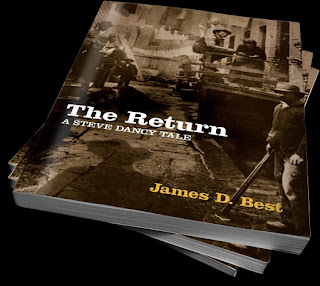
Final cover for The Return, A Steve Dancy Tale.


This is the full cover. I especially like the cowboy shadow the designer added.


The designers did a great job. As I mentioned in Get a Spine, the spine is crucially important because it is all a browser will probably see in a bookstore. Here are the six spines for the Steve Dancy Tales.


Do people judge a book by it's cover? Do book covers sell books? Yes and yes. Need evidence? Here you go.

You might also enjoy Vintage Photograph to Western Book Cover.

Wednesday, July 24, 2013

Released: The Return, A Steve Dancy Tale

Western adventure fiction


As of this morning, Amazon is offering The Return, A Steve Dancy Tale in print and Kindle formats. The hardcover large print edition is due from Center Point in the first quarter of 2014. Barnes & Noble and other retailers have not yet listed the book as available, but you can be sure I will let you know when that happens.

Amazon Print Link
Amazon Kindle Link


It's the summer of 1880, and Thomas Edison's incandescent bulb is poised to put the gaslight industry out of business. Knowing a good business opportunity, former New York shopkeeper Steve Dancy sets out to obtain a license for Edison's electric lamp. Edison agrees, under one condition: Dancy and his friends must stop the saboteurs who are disrupting his electrification of Wall Street.
After two years of misadventures out West, the assignment appears to be right up his alley. But new troubles await him in New York City. Dancy has brought a woman with him, and his high-society family disapproves. More worrisome, he has also unknowingly dragged along a feud that began out West. The feud could cost him Edison's backing ... and possibly his life.

Tuesday, July 23, 2013

Has a Western mash-up ever worked?

I’m not a purist. My own westerns are about miners instead of cowboys, my plots delve into the politics of the frontier, and my protagonist is a wealthy Easterner. I also liked the Lone Ranger, even though it went overboard on special effects and cuteness. I can go off the beaten track and even enjoy oddities like Cormac McCarthy’s weird punctuation. But mash-ups? Where did this fad come from? Mixing diametrically opposed genres is like fusion cuisine where the main course and dessert are lumped together in a stir-fried. It may be an interesting novelty, but it won’t change traditional menus.

I believe a fiction writer’s job is storytelling. It must be done well, with good characterization, but essentially the task at hand is telling a ripping good story. Effective storytelling takes people to another place and time. It can be the Wild West or Hogwarts School of Witchcraft and Wizardry. A mash-up tries to take the audience to two different places at two different times. It’s jarring.  Besides, these writers seem more concerned with how clever they can blend the genres, rather than storytelling.


Many Western enthusiasts lament the lack of audience for Western literature and film. Unfortunately, there will be no resurgence by mashing up Westerns with the latest teen craze. It’s not that easy. Intriguing characters with a well-crafted story arc will draw readers to any genre. Just ask Larry McMurtry, Elmer Kelton, Louis L’Amour, Owen Wister, Jack Schaeffer, John Ford, or Clint Eastwood.

Sunday, July 21, 2013

The Tricks Women do With Ropes


Steve Dancy Tales

I was wandering around YouTube and found a fun video of Eleanor Powell tap dancing her way through some impressive rope tricks. Reputed to be the best female tap dancer, Powell was the first wife of Glenn Ford. For the impatient, her roping begins at about 1:30 into the video.


Powell once said, "A tap dancer is really a frustrated drummer." To prove her point, she danced with Buddy Rich, reputed to be the world's best drummer.

And now for something completely different...

Friday, July 19, 2013

Top 10 Western Books


Steve Dancy Tales
 Reading Cowboy Statue, Azle, Texas

American Cowboy magazine has listed the top 10 Western Books, plus a few also-rans from the same authors. Many of these novels were made into classic films, which shows that good storytelling can be adapted to multiple mediums.

By the way, I searched through the list twice, but never found any of the Steve Dancy Tales. I'm sure this is an oversight that will be corrected in the next list. 


Actually, I believe they compiled a fine Top 10. I've read 8 of the 10 ... an omission I'll correct shortly.

Steve Dancy Tales
Illustration by Zachary Pullen