Wednesday, January 29, 2014

How not to bore your readers

Charlie Jane Anders wrote a piece for io9 about How to Write Descriptive Passages Without Boring the Reader or Yourself. Her article includes some good advice, including:

  1. Commit to never being boring.
  2. Engage all five senses.
  3. Try being super terse.
  4. Make it dynamic rather than static.
  5. Make fun of the thing you're describing.
  6. Project feelings onto an inanimate object.
  7. Give your POV some visceral or emotional reaction.
  8. Use less dialogue.
  9. Use description to set up a punchline in dialogue.

I would add three more for an even dozen:
  1. Never start a book or chapter with too much description.
  2. Interleave description in small doses.
  3. Write about interesting places.

ghost town
Candelaria (aka Pickhandle Gulch)

I usually start chapters with action and then intersperse tight paragraphs of description. I prefer delivering description in a single paragraph at a time and seldom have more than two descriptive paragraphs in a row.  I also like to write about interesting places. Novels will take you to mundane locales, but you can always insert an interesting detail. 


The Steve Dancy Tales start in a Nevada mining camp called Pickhandle Gulch. I walked the current-day ghost town, fascinated by the miners’ rock igloos.  (The town must not have discouraged littering because the mouths of these rock dwellings were strewn with hundreds of rusted tin cans.)

Here is how I described the camp in The Shopkeeper.
Pickhandle Gulch nestled between the Silver Peak Range and the Excelsior Mountains. The main road curved up a mild grade toward a stamp mill, an ugly building that pulverized rock and made a nerve-racking noise all day long. About two dozen thrown-together buildings lined either side of a road, and hundreds of hovels scarred the surrounding slopes. Miners built these shelters with rocks because the beige hills that rolled off in every direction were completely barren of trees. For that matter, hardly any foliage reached above a man’s boots, and even the valley spread out below presented only a relentless brown landscape spotted with a few rocks and some pale sagebrush. Lumber was the second-dearest commodity in town. Water was the first.

western fiction
Honest westerns ... filled with dishonest characters.

Monday, January 27, 2014

Why are murder mysteries written in first person?

detective
Murder mystery fans like to figure out whodunit. It’s why the genre is fun, and enthusiasts hate it when the author rigs the game. No undisclosed facts or coincidences can miraculously solve the crime. Everything known to the detective must also be known to the reader. The most effective way to share information is to tell the entire story in first person. First person requires the narrator to be present in every scene, so everything she sees, the reader sees. Thus, most murder mysteries are written in first person in order to insure a fair challenge.

All the facts must be commonly known, but it’s legitimate to shield the reader from the thoughts of the detective. This is why many authors don’t use the protagonist’s point of view. The first person character can be a narrator sidekick, like in the Sherlock Holmes mysteries which are told by Dr. Watson. This is a handy device for facilitating a surprise ending. Although readers get to know all the facts, they don’t see the detective mentally unravel the incongruities of the mystery.

When I was figuring out a plot for the third Steve Dancy Tale, it occurred to me that I had all the elements in place for a murder mystery. I had started the series in the first person and another main character worked for the Pinkerton National Detective Agency. Everything fit for a murder mystery disguised as a western. Murder at Thumb Butte is a murder mystery that just happens to occur in the Arizona Territory. Since there were plenty of murders in the Old West, why couldn’t a mystery surround the one Steve Dancy needed to solve to save a friend? 

western fiction
Honest Westerns ... filled with dishonest characters

Friday, January 24, 2014

Time, the Magic Elixir—Set Your Novel Aside for a Spell

Partial Outline for Tempest at Dawn

I believe novels are like wine, they need to age in a metaphorical cask for just the right amount of time. The chart on this page was a timeline I developed for Tempest at Dawn, my novelization of the Constitutional Convention. This chart reflected what happened during May, 1787, the first month of the Constitutional Convention. (Each number has extensive hidden notes.) I also develop separate charts for each of the following three months, plus similar charts for before and after the convention. My table for the cast of the story retained an unbelievable amount of data on all fifty-five delegates plus a dozen or so outsiders. I had spent three years studying the convention and the framers. It was a daunting task and I wanted to squeeze everything into my novel. To quote Pretty Woman, “Big mistake. Big. Huge.”

Constitution
The real story of our nation's founding.
My original draft was over 240,000 words. My agent harangued me to cut, cut, cut. By the time he agreed to shop the book, it was about 175,000 words. Despite his enthusiasm, it didn’t sell, and I threw the manuscript into a drawer (actually a computer file folder) for several years. After I had successfully self-published a western series and The Shut Mouth Society, I decided to take another look at Tempest. I felt I had captured the story, but diffused the drama with too much detail. Now I went after the manuscript with hedge clippers instead of scissors. After that, professional editing and proofreading got the final published manuscript down to 140,000 words. Still a big book, but now it moved with an energized pace.

Time was the medicine that cured the ills of Tempestat Dawn. I got far enough away to lighten my emotional attachment to the project. Writing a book is consuming, but intensity can also cloud judgment. 

After your final draft is done, set it aside for a bit and let your book mellow. Does it need to be years? Absolutely not. When I finish a novel, I go on a trip. Get some real distance between me and the book. I prefer going surfing or taking a road trip with friends. Something that feels like a reward. It can be as short as a week, and is seldom more than a month. For me, travel shortens the time I need to be truly objective about the final draft.  Every writer is different, so this may not be the best way for you to clear your head. I only know that I do solid revisions after getting mentally and physically away from the book for a spell.

One last thing: it’s not easy to abandon your book. There’s excitement on completion and an anxiousness to get it out there because it’s your best work to date. Probably true, but it can always be better. Give it a little time and look at it again with fresh eyes. (I also have a couple of trusted people read and comment on the book while I’m gallivanting around.) Try it once and see if it works for you. Like I said, every writer is different.

Tuesday, January 21, 2014

Outline a Novel?

Joseph Heller's Outline for Catch 22

How much planning should there be for a novel? Should there be an outline? Should you compose character sketches? How much research after the first draft?

My answer to all of these questions is that it depends.

Tempest at Dawn is a novelization of the constitutional convention. Prior to writing the first draft, I had visited Philadelphia twice, complied biographical information for the primary delegates, built a small library about the convention and eighteenth century lifestyle, created a highly detailed convention timeline, extensively marked-up Madison notes, acquired an 1787 map of Philadelphia, and secured architectural layouts for the State House. I knew the content of every chapter well before I started writing.


The Shopkeeper is the first in the Steve Dancy western series. I did zero research prior to the first draft, nor did I have an outline. Although I had nothing on paper, I mentally knew the beginning and end of the story, but how I would get from one point to the other was vague.  I also knew my main character and his sidekick, but the other characters evolved as the story progressed. After I finished the first draft, I collected some friends and did a road trip through Nevada to explore locales for the story. In fact, I asked my ghost town enthusiast friend to find me a mining camp within a few days horse-ride of Carson City. She did, and that is how the story opened in Pickhandle Gulch. After I did the Nevada research and investigated mining in the state, I rewrote the book from beginning to end.


These are two preparation extremes. Why the difference from the same author? Tempest at Dawn was a dramatization of arguably the most important event in the founding of the United States. Accuracy was paramount. It had to survive the scrutiny of professional historians, which it did with flying colors. The Shopkeeper was pure fiction with historical detail limited to locale and nineteenth century lifestyle.  The story was paramount. I wanted to get the story and the characters down on paper before interweaving detail that would make the novel feel right for the Nevada frontier.

The bottom line is that I do what feels right for the project. I don’t believe there is a right and wrong way. There is good advice out there from successful writers, but I believe good writers do what is natural for them. So … my advice is to go with your instincts.

Sunday, January 19, 2014

History Rides Shotgun—Excellent Advice


Jennifer Cody Epstein published, “10 Rules for Rewriting History” at Writer Unboxed.  As a historical writer, I found the article helpful and full of great advice. I think I've encountered all 10 issues, but number one, History Rides Shotgun, is my nemesis. I enjoy research and like fascinating factoids. It’s difficult for me to not look for a place to tuck in a real life incidence or coincidence that I think is interesting all on its own.

Epstein writes, “Remember that what you’re writing is a novel—not a history book. This means history should be used only to heighten and deepen your narrative, and not the other way around. Be careful not to get hijacked by some fascinating event that doesn’t fit naturally into your storyline, because no matter how hard you try it simply won’t work in the end. If it doesn’t relate to your plot, it shouldn’t be in there.”

Solid advice. I have a proclivity to violate this rule, so I need to be vigilant during revisions to look for extraneous information that does not advance the story.

action adventure suspense thriller
Honest westerns ... filled with dishonest characters
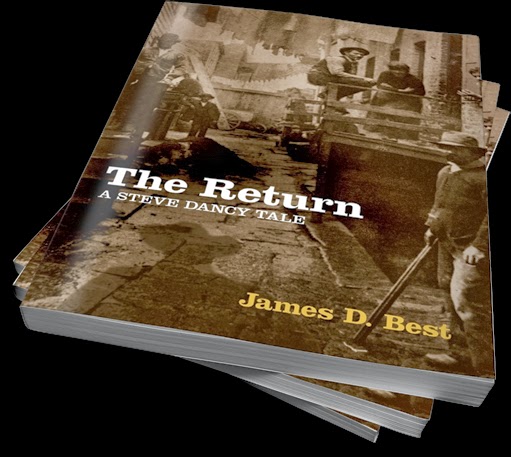
In the latest Steve Dancy Tale, The Return, Dancy and Sharp travel to see Thomas Edison in order to secure rights to his inventions for mining. In the research for the novel I discovered all kinds of interesting things about Edison, Menlo Park, New York City, and 1881 movers and shakers. I was also startled to discover that Edison owned mines and developed numerous patents that applied specifically to mining. It was difficult to avoid letting the Wizard of Menlo Park interfere with Dancy’s story. I succeeded by scrubbing the story during revisions and being conscious that this was a particular problem for me. I also used a technique that I’d like to add as a tip to Epstein’s Rules. At the end of the book, I added a “Historical Note.”  Through this device I was able to inform the reader about some historical tidbits without disturbing the flow of the story.

Related Posts

Wednesday, January 15, 2014

Opposites Attract ... readers, viewers, and fans

Television series
Steed and Peel

Joe Bunting has a good article on literary foils at The Write Practice. Captain Kirk and Mr. Spock, John Steed and Emma Peel, The Lone Ranger and Tonto, Homes and Dr. Watson, Martin Riggs and Roger Murtaugh, Cole and Hitch, among many others. I’m inclined to favor a good buddy story over the lone protagonist. I even prefer James Bond when the rule-following CIA agent Felix Leiter is around.

Use literary foils to maintain tension when there are no bad guys within sight. As can be seen from these few examples, famous literary foils possess opposite personalities. That’s why on television cop shows, partners are contradictory. They can play off each other in any circumstance. This device makes it easy to generate low-key tension when the protagonists are disengaged from battling whatever has irked their ire.


Bunting correctly points out that literary foils can also be a love interest or an antagonist. When an antagonist is used as a literary foil, the relationship goes beyond rivalry. There’s an emotional tie between the two. In other words, the protagonist and antagonist are in a relationship. Homes’ long-running battles with Moriarty and Clarice Starling against Hannibal Lecter come to mind, but I’ve always been partial to Wile E. Coyote and the Road Runner.

western fiction
Cole and Hitch

Literary foils are an indispensable tool for writers. The Steve Dancy Tales is written in the first person, so without Jeff Sharp and Captain McAllen, it would be necessary to rummage around inside Steve head to get a feel for who he is and what he’s about. That would be boring. But with two contrary foils, Steve can interact with his friends and his personality is shown, not told. In The Shut Mouth Society, Greg Evarts and Patricia Baldwin are opposites in every conceivable way. The relationship makes it easier to keep the tension taut in this thriller.

There is an old saying that opposites attract. I’m not certain about life, but they certainly attract readers and viewers.

Tuesday, January 14, 2014

Crazy Book Dedications

Nelson DeMille

The Barnes and Noble Book Blog published a list of 25 odd, clever, or humorous book dedications. Ever since Cathedral, Nelson DeMille has been one of my favorite authors. His dedication for Wild Fire is my favorite, although it’s attached to my least favorite DeMille book. I remember when Wild Fire was first published, I laughed when I read the dedication. Unfortunately, the rest of the book was a disappointment.


I have never tried to be clever with my dedications. Most of them simply state one or more family member's first names. I did get verbose with Leadville, dedicating the book in the following manner to my twin grandsons.  

For Leo and Eli
Hey boys, I finished Leadville in the hospital when you were born


The dedication for Anansi Boys, by Neil Gaiman is another favorite.
You know how it is. You pick up a book, flip to the dedication, and find that, once again, the author has dedicated a book to someone else and not to you.
Not this time.
Because we haven’t yet met/have only a glancing acquaintance/are just crazy about each other/haven’t seen each other in much too long/are in some way related/will never meet, but will, I trust, despite that, always think fondly of each other!
This one’s for you.
With you know what, and you probably know why.

Gaiman’s dedication reminded me that I used to subscribe to Forbes to see my name on the cover of their 500 Richest People in America issue. Of course it was only on the address label, but proximity to all those successful people filled me with hope for the next year. If you would like to help me fulfill my dream of obscene wealth, please buy one of my books. Thank you and I promise to dedicate my next book to you.


Sunday, January 12, 2014

How to Sell a Half Million Books—After You’ve Been Dead 100 Years

Dead people publish new books all the time. Some of these books are unfinished manuscripts. Others are ghostwritten from scratch to take advantage of a famous name like Robert Ludlum. But there is one book composed by the actual author that was purposely withheld from the market for one hundred years, and after release, sold over a half million copies. Now that’s quite a feat.

western writers
Click to buy at Amazon
The author, of course, is Mark Twain, and the book is his autobiography … Volume 1. (The New Yorker has a fine article about Twain’s autobiography.) The second volume has just been released and is also projected to sell well. 

Twain specified in his will that his autobiography could not be published until 100 years after his death. He claimed that time would heal the wounded egos of those he assaulted. There is a lot of vitriol aimed at long forgotten people, but the only controversial aspect of his own life is an atheism well known by his contemporaries. In typical Twain humor, he wrote, “I have thought of fifteen hundred or two thousand incidents in my life which I am ashamed of, but I have not gotten one of them to consent to go on paper yet.”


The delayed publication was a grand publicity stunt by one of our nation’s foremost self-promoters. Twain believed, no, he knew that the great great grandchildren of his current readers would be interested in his life. He expected immortality of an earthly variety … and he was right.

The meandering style of the book has not garnered good reviews. Twain wrote that other autobiographies “patiently and dutifully follow a planned and undivergent course.” His own, by contrast, is “a pleasure excursion.” It “sidetracks itself anywhere that there is a circus, or a fresh excitement of any kind, and seldom waits until the show is over, but packs up and goes on again as soon as a fresher one is advertised.”


Related Posts